













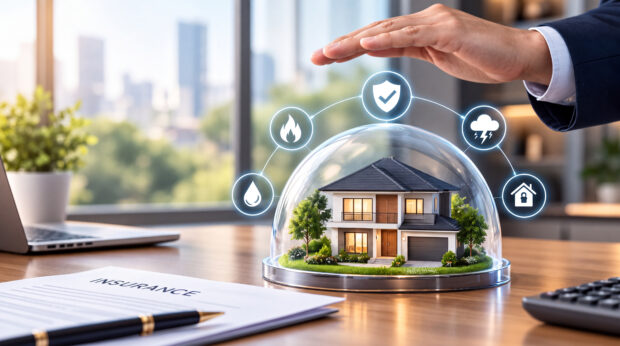
The homeowners insurance policy of the future may look more like a collection of coverage options to meet each policyholder’s specific needs rather than one singular solution.
At least, that’s the direction envisioned by Arik Yelovitch, chief technology officer and co-founder of Adaptive Insurance. He discussed parametric products and climate-related coverage gaps during a Carrier Management interview at this year’s Insurtech Connect conference in Las Vegas.
“I’m not here to predict the future, but I think the days of selling one insurance policy that covers everything are numbered,” he said.
Yelovitch added that he expects traditional homeowners insurance to continue providing essential protection, with specialized insurers offering supplemental products. He compared the approach to consumers subscribing to multiple streaming services rather than relying on one provider for everything they want to watch on television.
For Adaptive, which began with parametric power outage coverage and has expanded its focus to flood, wind, hail and other specialty exposures, he sees opportunity in filling those gaps rather than attempting to replace a standard homeowners policy.
“With Adaptive, we go further, and now we cover specialty lines that help to bridge gaps that exist in the market,” he said. “We come to relieve the pain—because it’s a pain, right? I’m not talking just a monetary pain. It’s also emotional pain the moment something happens to your house. So, when we come and help cover that gap, whether on power outage, on flood, or other products we build, we build a specific plan for that aspect of coverage rather than just coming in with a whole solution.”
The Golden Triangle of Parametric
He said three conditions make a risk suitable for parametric insurance: data must be available, that data must be usable for decision-making, and an event must be trackable in real time to establish whether a payment trigger has occurred.
“Basically, it’s the golden triangle of parametric,” he said.
Unlike traditional indemnity coverage, which typically requires assessment of a covered loss, parametric insurance relies on a predefined event or threshold. The question is whether the event occurred rather than how an adjuster interprets the damage after a policyholder reports it.
“Parametric is a very deterministic claims process with a trigger event, meaning it’s either happened or it didn’t happen,” he said. “It has to be empirical.”
That distinction can translate into faster payments, he said. Adaptive’s process uses event data to initiate a claim, with payment targeted within roughly 72 hours of the event. Although the data may still require some customer confirmation, a qualifying power outage could produce a payout even if electricity remains unavailable for several days, he explained.
This approach also can change a customer’s experience with policy language and claims disputes, he said.
“There’s no human to move the needle. There’s no adjudication, meaning the adjuster comes and start arguing with you on what happened and when, and you’re at risk of losing your coverage because of some things you didn’t say or misspoke,” he said. “Because the [parametric] policy, at the end of the day, is a contract between you and the insurance company: You pay a premium, and they pay you a claim if something happens. A parametric contract is very, very simple. It’s like ‘This will happen, this is what you’ll get,’ and maybe a few inclusions.”
‘Agents Are Not Going Away’
Although parametric contracts may be simpler, Yelovitch does not believe technology removes the need for human intervention.
“The agents are not going away,” he said. “Some people are more technology oriented and they prefer to do everything themselves, but insurance overall is not a simple product to understand. It’s a simple concept, but not a simple product. Agents are key.”
Looking ahead, he said he believes the continued spread of sensors and increasingly detailed data on wind, hail, flooding and water-related events will create more opportunities to develop parametric coverage. That expansion could support a market in which primary carriers provide foundational homeowners insurance while specialty providers offer additional coverage tailored to particular exposures, he added.
“The more sensors we have for wind and hail, the more sensors we have for floods and water, it will be easier to penetrate the parametric market,” he said. “We know there is damage, and you’re getting paid.”
 APCIA Says Claims Data Standards in Works to Better Combat Criticism
 The Latest Launches from Insurify, Insurity
 Human Error, Systemic Failure Blamed for Spain’s Latest Deadly Train Crash
 Hippo Continues to Diversify Portfolio in Q3 With Casualty, Commercial