



















In an August interview with Bloomberg, Microsoft CEO Satya Nadella referenced a 1995 internal memo from the company’s then-CEO Bill Gates titled “The Internet Tidal Wave,” saying he believes the impact of artificial intelligence will be just as profound. And while experts say benefits await those who are brave enough to test the waters of AI, many insurance carriers still seem cautious about the risks.
Executive Summary
Talent and tech officers of P/C insurance operations spoke with CM Deputy Editor Elizabeth Blosfield about the benefits of AI for their companies’ workforces and their own jobs. They discussed the fears that are holding some companies back and the best steps to guide human talent forward. Employment lawyer Holly Goodman also described risks for carriers as the use of AI tools becomes more common in human resources departments.
Michael (Fitz) Fitzgerald, Insurance Industry Advisor for SAS Institute Inc., served as guest editor for this article and others featured in CM’s Q1-2024 magazine, “Leading the AI-Powered Insurer.“
Related video content: Robots vs Humans: How Will AI in HR Impact Carriers’ People-First Approach?
“Those fears are real,” said Gordon Wintrob, co-founder and chief technology officer at Newfront. “It goes back to how difficult it is to change or to do things differently.”
Newfront is an insurance brokerage that markets itself as a modern business insurance company, and Wintrob said he sees AI as the next computing revolution.
“Mobile phones brought a wave of innovation. The movement from mainframe computing to the cloud was another breakthrough revolutionary change. I think AI is doing the same thing across the entire economy,” he said. “To think of it as this limited thing that’s only going to maybe impact a limited number of products or services is the wrong way to think about it.”
Wintrob believes insurers and brokers should be asking themselves, “How do we train and arm our employees to be able to take advantage of all this innovation and think of things through the AI lens?”
The challenge, he said, is conquering fear.
“It’s a lot of change,” he said, “and change is always hard.”
Blair Kamrass, vice president of people at Coterie Insurance, also pointed to the early days of the Internet to address the fear of using AI in carrier operations.
“You know, the same fears held true just from the people and operations perspective of automating employee files back in the day,” she said. “I know in some places, there were these massive filing cabinets of employee records and the thought of making them digital just really scared a lot of people. But again, it’s almost like these baby steps of getting people to understand that this is the new world we live in.”
Coterie is an insurance technology company with a focus on small business insurance, and Kamrass said AI is in the early stages of implementation across company operations.
“It’s on our road map for 2024 to really start just analyzing: What do we want to do? What do we want to start with? And then what will we build on from there?” she said.
Humans vs. AI: Preparing for Innovation
Training employees and arming them with knowledge about AI starts with human resources, which is one area of focus for AI implementation at Coterie. Kamrass oversees the company’s operations regarding benefits, compensation, payroll and employee engagement.
“I think from the HR perspective, we know that AI’s goals are to increase efficiency, improve accuracy and just really enhance the employee experience,” she said.
Related video content: Robots vs Humans: How Will AI in HR Impact Carriers’ People-First Approach?
Ken Gregg, founder and CEO of homeowners insurance company Orion180, said his company has used large language models—an artificial intelligence program that can recognize and generate text—to refine job descriptions, create companywide policies, summarize documentation or create presentations.
“Outside of customer service and some claims intake, most of the applications of AI thus far have been tools that greatly assist our professionals in performing their jobs more efficiently,” he said. “While this may slow the rate at which companies need to add headcount, it does not replace the existing talent. It enables them to leverage their critical thinking and creativity.”
If concerns about AI replacing human jobs are holding carriers back from embracing it fully, Gregg said he’s navigating these fears by emphasizing his company’s intent to maintain personal human interaction as a core value.

Blair Kamrass, Coterie Insurance: “When you think of just your average tech tool, they’re typically depreciating assets of the company, whereas a person should be an appreciating asset where you’re investing in their development and their growth.”
This is also true at Nationwide, where Chief Human Resources Officer Vinita Clements sees AI as introducing new efficiencies into the employee management process.
“One of the most impactful benefits of AI we’ve seen in HR is the ability to connect employees to information more quickly and efficiently,” she said. “We believe the strategic integration of generative AI offers a powerful way to create a bionic workforce that can drive greater value and impact in the marketplace. Humans lead in a bionic workforce because humans are accountable for decisions and outcomes, not the machines.”
Clements added that by combining the empathy and judgment of human workers with the speed and efficiency of machines, human workers can focus on higher-value tasks that require a relationship-based approach while AI models can take on repetitive, lower-value work.
“Our HR team is preparing employees to use and experiment with generative AI by helping them understand the potential, educating on known risks, and creating learning opportunities that include self-guided trainings and outside speakers,” she said.
Kamrass said it’s also helpful to position AI as another employee to be trained and integrated into a company’s culture rather than a simple tech tool.

Vinita Clements, Chief Human Resources Officer, Nationwide: “We believe the strategic integration of generative AI offers a powerful way to create a bionic workforce that can drive greater value and impact in the marketplace. Humans lead in a bionic workforce because humans are accountable for decisions and outcomes, not the machines.”
“When you think of just your average tech tool, they’re typically depreciating assets of the company, whereas a person should be an appreciating asset where you’re investing in their development and their growth,” she said. “And I think AI needs to be thought about in the same way where it’s not going to sit on the shelf and you use it once a year. It’s something that will be eventually integrated into the very fabric of an organization and will constantly need to be evaluated to make sure that it’s producing the appropriate output to properly support the organization.”
(See related sidebar, “Meet Bob, Cover Whale’s AI Employee)
This work will likely be ongoing as the technology evolves, Clements said, and insurers will need to be deliberate with their workforce and training strategies going forward.
“We anticipated the need for a continuous learning culture many years ago,” she said. “We have already implemented specialized training into our comprehensive upskilling program. In addition, we have a thoughtful governance program in place aimed to educate and create awareness, train and develop, test and learn, and manage risks as well as opportunities.”
Big Benefits Pose Big Risks
Beyond training employees to work alongside AI, human resources teams are also navigating how to incorporate AI into their own work. Kamrass sees benefits in the recruitment and onboarding process, as well as with performance reviews.
“We’re actually in a performance review cycle right now at Coterie, and wouldn’t it be so great if we had an AI platform that could pull that together?” she said.
She sees AI as having the ability to pull documents and notes about employees from various platforms into a package for leaders to write performance reviews, adding that AI can also be useful in crafting employee policies or job descriptions and helping new hires sort through and understand onboarding documents.

Gordon Wintrob, Co-founder and Chief Technology Officer, Newfront: “At the end of the day, I do think there will be a lot of change, and [the successful ones] will be the folks who are able to embrace doing things differently and think about how AI plus humans can be much better than the sum of the two parts.”
Holly Goodman, a board certified labor and employment attorney and shareholder at law firm Gunster, said she also sees AI as being useful in crafting employee policies or job descriptions, as well as helping new hires sort through and understand onboarding documents. However, the use of AI in these functions is not without risk.
“The [functions] that are becoming more common are the ones that pose the most risk,” Goodman said, pointing to bias and discrimination as “the big issue” with including AI in HR.
“Just because it is artificial intelligence doesn’t mean that it’s not going to also potentially create scenarios where a business could be violating the laws or could be inadvertently discriminating against someone,” she said.
She said examining blind spots can go a long way.
“Perhaps it’s something as simple as using AI for recruiting processes, and you input that you want to eliminate any candidate who had a six-month or greater gap in their resume,” she said.
While this input may appear neutral on its face, she explained this AI prompt could inadvertently affect those who have taken parental or medical leave. She encouraged insurance companies to include bias training for AI into any discrimination and harassment training they’re already undertaking, especially if AI is going to be doing some of the tasks human employees are trained to do.
“What employers really need to be worried about and what HR departments need to be worried about is making sure they’re vetting those information points that they’re putting into the AI, and then also on the back end, evaluating outcomes to determine whether or not there’s any evidence of that kind of a negative or disparate impact,” she said.
This is where a healthy amount of skepticism comes in, Newfront’s Wintrob said. “Always have some steps where you ask a large language model to explain its reasoning and walk you through how it came to an output,” he said.
Kamrass at Coterie added it’s important to be mindful of language and data used to train AI models to avoid introducing bias and to implement company core values.
“We want to make sure that we are supporting a diverse, equitable, inclusive environment in every facet of everything that we do, and sometimes these AI tools, if they’re trained with biased data, they’re going to produce biased output,” she said. “Test different language to see what might stick.”
Beyond concerns of discrimination, insurers should also be thinking about data privacy risks, she said.
“Data privacy is enormous,” she said. “We don’t want to be uploading employee personally identifiable information because once it’s in some of these systems, we’re not always 100 percent sure where it’s going to go.”
This means thinking through current data governance practices and updating security protocols when necessary.
“As technology grows, so too do the threats,” Goodman said. “Businesses have a lot of personally identifiable information—insurance companies in particular, where you have people’s names, you have their addresses, you have their date of birth, possibly their Social Security numbers, you have a lot of personal information about individuals. You need to make sure that you have protections in place and limitations on the use of that data.”

Holly Goodman, Gunster: “What’s really important here is that all of the existing laws that deal with employment matters, that deal with even privacy outside of the HR space, those laws and those regulations are still going to apply even in the AI use case.”
She said insurers should be careful about the information uploaded into AI models because it could mean giving ownership of their data to the platform. She cautioned them to revisit their policies around the use of data and what can be uploaded into AI products.
“What’s really important here is that all of the laws, the existing laws that deal with employment matters, that deal with even privacy outside of the HR space, those laws and those regulations are still going to apply even in the AI use case,” Goodman said. “They were passed long before we ever even thought about something like artificial intelligence.”
Insurers should also examine any third-party vendors they might be working with to supply their AI models, she said.
“Even if the artificial intelligence that [carriers are] using isn’t their own, if they have a third-party vendor that they have outsourced a decision point to or that they have outsourced data analysis to and that third-party vendor is violating some of these regulations or laws, then that business who hired that vendor can also still be liable,” she said. “So, it’s really important to make sure that the business is aware of that third-party connection and is really vetting some of the policies and the use practices of third-party vendors.”
Kamrass said she believes despite some challenges, the insurance workforce is used to change and will be prepared for the changes that are coming with AI as human employees and machines learn to work together.
“You know the workforce has seen so many changes over the years and like anything else, it takes time and education,” she said. “There have already been a lot of tech advancements over the years. We’re already living through it. And the sooner that you can embrace that and of course ask questions along the way to make sure that you’re comfortable, then it will just take everyone further. It will take our companies further. It will take us as individuals further as we grow and develop. And I think it will be an exciting ride.”
After all, Wintrob said, two is better than one.
“At the end of the day, I do think there will be a lot of change, and [the successful ones] will be the folks who are able to embrace doing things differently and think about how AI plus humans can be much better than the sum of the two parts,” he said.
***
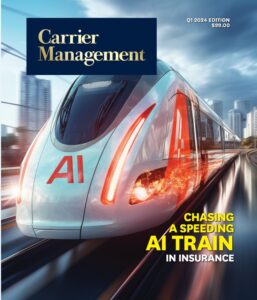 This article is featured in Carrier Management’s first-quarter 2024 magazine, “Leading the AI-Powered Insurer,” conceived by Guest Editor Mike (Fitz) Fitzgerald
Related articles include:
- Meet Your New Employee: Advanced AI
- Organizing for Action: The Board of Directors in the AI-Powered Insurer
- AI Leadership at All Levels
- Critical Thinkers Needed for AI-Powered Insurers
- Stick to Purpose: Why Carriers Should Cooperate on AI
- Dual Skills Needed to Sit on Boards of Tech-Savvy P/C Insurers
- Chief Risks Officers Take on AI
All of the articles in the magazine are available on the magazine page of our website.
Click the “Download Magazine” button for a free PDF of the entire magazine.
To be able to read and share individual articles more easily, consider becoming a Carrier Management member to unlock everything.
 The New Corporate Status Symbol Is How Much AI Access You Have
 Road Deaths Declined to Historic Levels in First Half of 2026
 Xceedance Says for Insurers, AI Advantage Is in Orchestration
 INSTANDA CEO Sees Governance, Human Oversight As Top AI Priorities