




















Bottom-line impact from technology investments starts at the top for property insurers.
At HSB and the IoT Observatory, we believe that simply offering sensor technology through InsurTech marketplaces or discount programs across a book of property insurance policyholders—and hoping for significant adoption—is not a sustainable risk-mitigation approach that will produce long-term profitability or competitive advantage.
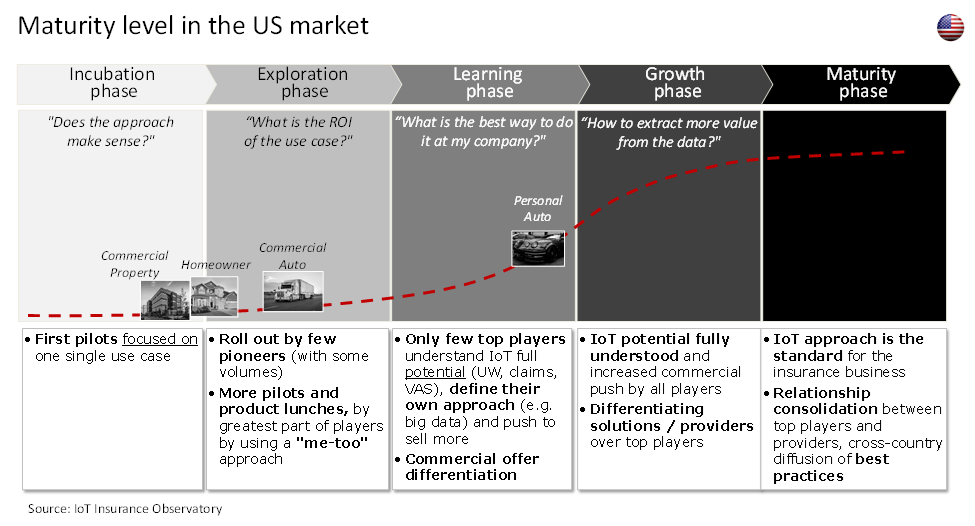
Some U.S. property insurers have started their IoT journeys, but the overall level of maturity is still nascent compared to other insurance business lines. While IoT is a part of these insurers’ suites of loss control tools, and the success stories are emerging, industrywide literacy about the IoT paradigm and its applications are still low. That said, some players are scaling significant books with a strategic mindset, including State Farm, and initiatives have emerged where coverage eligibility is dependent upon the use of approved IoT-based prevention solutions.
Regrettably, it remains all too common to witness insurers adopting IoT-based risk prevention as a supplemental activity, as opposed to truly integrating it into their core strategy. These insurers are prone to adopting approaches that do not result in any profound impact on their causes of loss. Equally concerning, book penetration is often very low for insurers that implement IoT in this fashion.
Common tactics today include:
- Offering sensor giveaways in exchange for policy signups but never bothering to track if the policyholder has installed or if the solution is online.
- Referral programs, where policyholders can go online and pick from a hodgepodge of uncurated solutions—paired with premium discounts and/or device discounts that are too small to truly motivate signup, much less installation.
- Loosely established programs that are missing a coherent scale strategy to align target customers, value proposition, IoT use cases and go-to-market.
- “Toe-dipping” trials and pilots to test devices, without an adequately-sized test population or meaningful pilot criteria to understand true efficacy, value or operational impact.
These initiatives are well-meaning but produce poor outcomes, including:
- Very low adoption rates by policyholders, typically ranging from 3-5 percent.
- Rapidly dissipating internal commitment to the program, often resulting in insurers being burdened with stockpiles of unused sensors.
- Disappointed IoT device companies, as signed contracts fail to generate long-term volume, and pilot projects that yield no substantial outcomes.
The end result of these poorly designed and executed initiatives is a perception that “IoT does not work,” leading to the premature termination of IoT initiatives and inhibiting greater industry adoption. In turn, some insurance-focused IoT solution providers have suffered profitability issues, while others have completely withdrawn from the insurance sector.
Integrating the technology into the insurance experience is where results will be realized. This is where Predict and Prevent, and ultimately Connect and Protect, can and will work.
Related articles: Creating the Tipping Point for Insurance IoT: How HSB and Its Partners Are Creating a Playbook for the Future; The State Farm Vision: Ecosystem Capabilities for the Insurer of the Future
 Building Trusted Insurance Brands: How Nationwide Delivers Tangible Value to Customers
  Viewpoint: The One Thing Holding Back Insurers’ AI Efforts
  Workers’ Compensation’s Real Challenge: Orchestration
  Levers and Guardrails: How Growth Is Being Built at Hippo