














Global business leaders and risk experts see more turbulent near- and long-term risk horizons, with geopolitical risks now topping weather and technological risks as immediate risks, according to the latest World Economic Forum’s Global Risks Report.
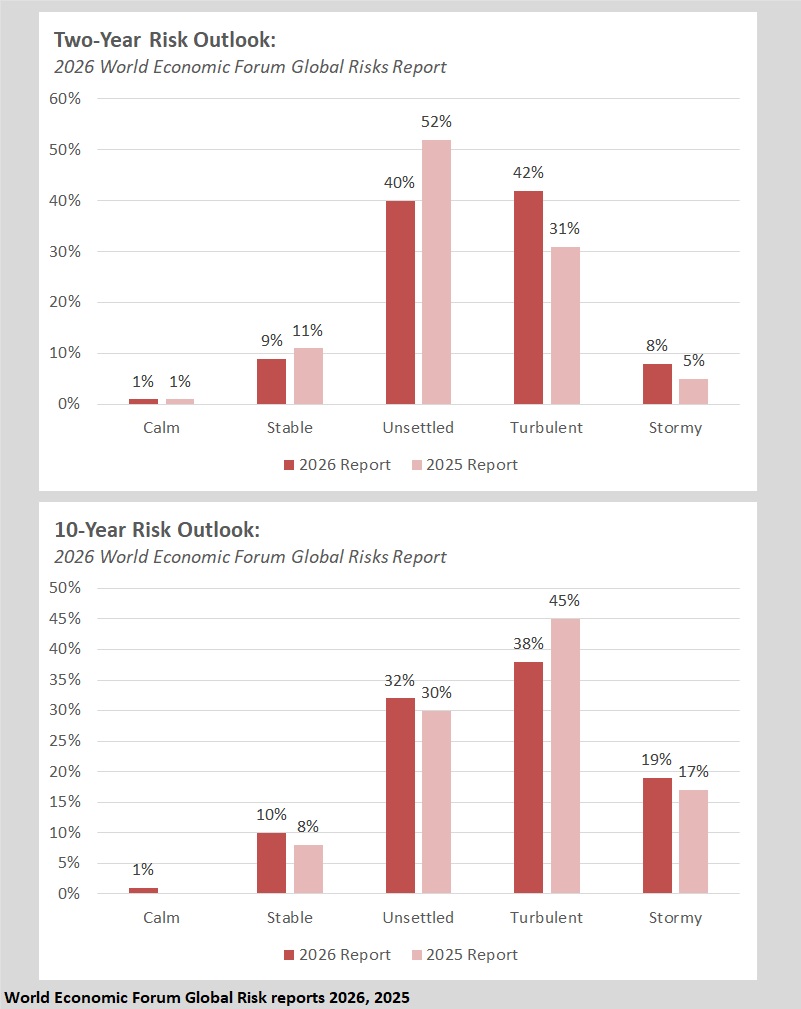
According to the 2026 version of the report, released yesterday and announced by Forum strategic partners Marsh and Zurich Insurance Group, half of 1,300 risk experts surveyed in August and September last year characterized the risk landscape of the next two years as “turbulent” or “stormy.” In contrast, only 36% offered similar characterizations when surveyed in 2024 for the 2025 version of the report.
Over a 10-year timeframe, 57% of the latest cohort of risk experts said the risk environment is “turbulent” or worse, compared to 62% in the prior report.
In terms of specific risks that businesses will face, geopolitical risks are top of mind for near-term (one- and two-year) time horizons, according to the global leaders and experts across academia, business, government, international organizations and civil society who were surveyed. The 10-year outlook, in contrast, is strongly dominated by environmental and technological risks.
For the year 2026, survey takers ranked “geoeconomic confrontation” and “state-based armed conflicts” as the top two immediate risks.
“Geoeconomic confrontation”—sanctions, tariffs, and investment screening—refers to the “deployment of economic levers by global or regional powers to reshape economic interactions between nations, restricting goods, knowledge, services or technology with the intent of building self-sufficiency, constraining geopolitical rivals and/or consolidating spheres of influence,” according to a definition section of the report.
The two geopolitical risks are followed by “extreme weather events,” “societal polarization,” and “misinformation and disinformation” on the current risk ranking for 2026.
Specifically, survey takers were asked to select one risk they believed was “most likely to present a material crisis on a global scale in 2026.” The final rank is based on a simple tally of the number of times a risk out of a pre-selected list of 33 possible risks was identified.
The top five risks identified for the 2026 match those selected by survey respondents in the prior (2025) report, but the ordering is different. In the latest report, “geoeconomic confrontation” rises to the top spot now, and both “state-based armed conflicts” and “extreme weather events” each moved down a notch.
Related articles: WEF Survey: Conflict, Disinformation Join Weather as Top Global Risks (2025); Trade and War Worries Haunt Davos as World Seen ‘on a Precipice’: WEF Survey (2026)
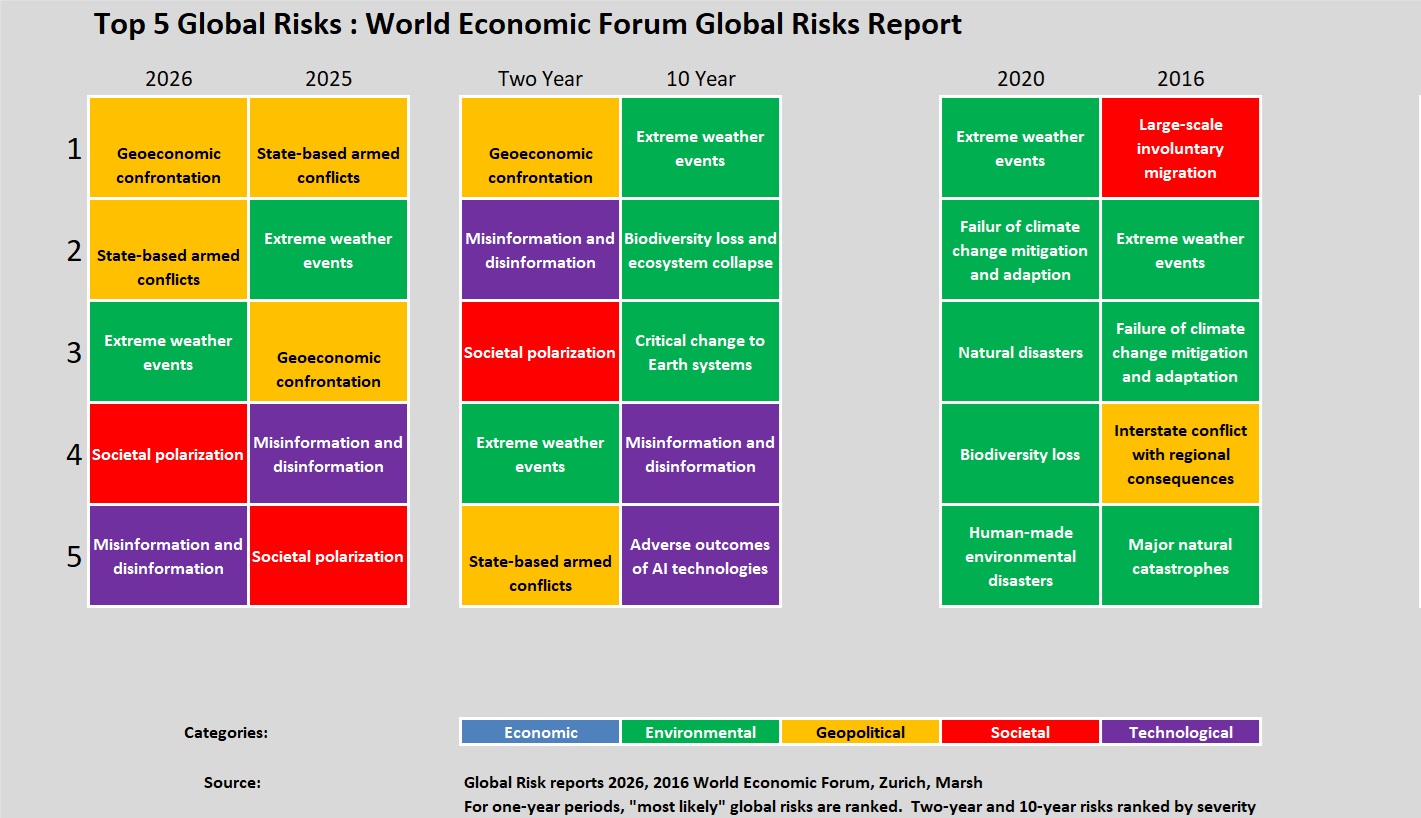
For the two-year and 10-year risk rankings, respondents estimated the likely impact or severity of each of the risks on a scale of 1 to 7 (7= highest severity). The rankings for these longer time periods are based on simple average scores.
The same five risks show up for the one-year and two-year time horizons. But over the next two years, “misinformation and disinformation” rises to second place in the ranking of severe risks.
Another technological risk, “adverse outcomes of AI technologies,” shows up as the fifth-most impactful risk over the course of a decade.
The three top risks—judged as the most severe over the next 10 years—are all environmental risks. Ten years ago, environmental risks were also identified as three of the five most likely risks of 2016. And four years later, environmental risks swept the board, according to respondents to a similar survey published in 2020.
(Editor’s Note: The makeup of the prior surveys was slightly different with questions framed as “most likely” and “most impactful” for the coming year. Environmental risks also captured three of the five “most impactful” spots in 2020, prior to the COVID pandemic, after which economic risks rose to the top.)
Related article: Top Risks Revisited Post-COVID
Regional Differences
An interactive display on the World Economic Forum website allows users to display responses to various survey questions for different regions of the world. There’s at least one notable difference between North American and European respondents asked to select one of 33 risks as the most likely to present a material crisis this year.
While Europeans selected the same five current risks as all survey respondents, in North America, the risk of “extreme weather events” dropped out of the top five. “Erosion of human rights or civic freedoms” entered the top five list for North America, coming in a No. 4, and “misinformation and disinformation” comes in at No. 2, replacing state-based armed conflicts.
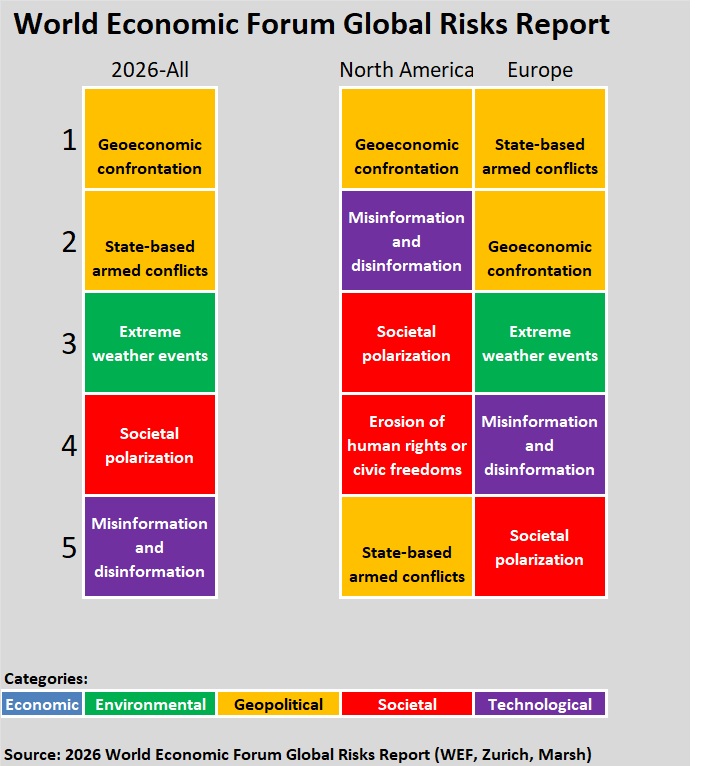
Weather events are ranked No. 6 among current risks for North America.
The societal risk “erosion of human rights” is defined as “loss of protections for rights inherent to all human beings, regardless of individual status, and/or the freedoms that underpin civic space.” This includes but is “not limited to the right to: life and liberty; work and education; freedom of expression; peaceful assembly; non-discrimination based on gender, race ethnicity and other characteristics; and privacy.”
What About Cyber and Technology Risks?
“Misinformation and disinformation”—defined as “persistent false information (deliberate or otherwise) widely spread through media networks, shifting public opinion in a significant way towards distrust in facts and authority”—is the lone technological risk to rank among the top five likely risks of 2026 and top five severe risks over the next two years.
Two other technological risks—”adverse outcomes of AI technology” and “cyber insecurity”—ranked as Nos. 8 and 9 among current risks.
Those results stand in stark contrast to a separate “risk barometer,” published by Allianz.
Related article: AI Is the Biggest Mover on Allianz Risk Barometer; Cyber Takes Top Spot for Fifth Year
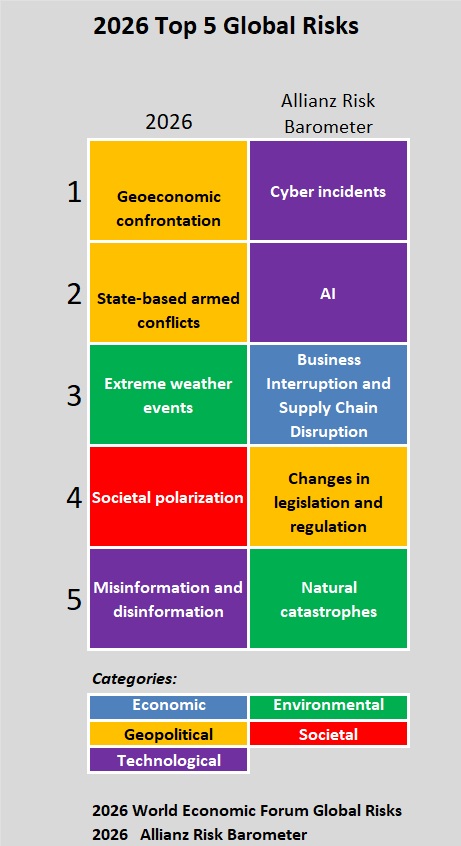 According to the Allianz Risk Barometer for 2026:
- “Cyber incidents” takes the top global business risk for the fifth straight year, with its highest-ever score (42 percent of responses).
- Cyber ranks as the main corporate concern in every region (Americas, Asia Pacific, Europe, and Africa and Middle East).
- “Artificial Intelligence” ranked No. 2, up from No. 10 in 2025—marking the biggest jump in this year’s ranking.
- “Natural catastrophes” and “climate change” (or “physical, operational, and financial risks as a result of extreme weather”) ranked lower (fifth and sixth).
- “Political risks and violence,” somewhat comparable to the WEF’s “state-based conflict” category, ranked No. 7.
- “Changes in legislation and regulation,” ranking fourth on the Allianz Risk Barometer, is described with the examples “tariffs, new directives and sustainability requirements.” Tariffs are also a descriptor for WEF’s top-ranked category, “geoeconomic confrontation.”
Importantly, the Allianz survey appears to ask a slightly different question with the focus on specific risks to business rather than “risks most likely to cause a crisis on a global scale,” which is the Forum’s qualification for inclusion on the current risk list. More specifically, respondents to the Allianz survey were asked to select the industry about which they were particularly knowledgeable and to name up to three risks they believed to be most important.
The Allianz Risk Barometer, compiled by Allianz Group’s corporate insurer Allianz Commercial, together with other Allianz entities, incorporates the views of 3,338 risk management experts in 97 countries and territories including senior managers, risk managers, brokers, and insurance experts. This corporate risk survey was conducted on October and November of 2025 among Allianz customers (businesses around the globe), brokers and industry trade organizations. The views of risk consultants, underwriters, senior managers, claims experts, as well as other risk management professionals in the corporate insurance segment of Allianz Commercial and other Allianz entities were also included.
According to Allianz, responses were distributed among large (44%), small (31%) and mid-size companies (24%).
An Overlooked Risk: Critical Infrastructure
With AI-related risks ranking second in the Allianz report and eighth in the World Economic Forum report, insurance entities have announced that they are ramping up coverage for data centers and power generation clients in recent days. FM announced it is offering the highest coverage limits of the group, bumping capacity to $5 billion.
Separately, Aon said it expanded Construction All Risks, Delay in Start-Up (DSU), and Operational Property Damage and Business Interruption coverage limits for data centers to $2.5 billion under a multiline “Data Centre Lifecycle Insurance Program,” which also includes cyber ($400 million), third-party liability ($100 million), and cargo and transport ($500 million) covers.
In addition, Advanced Technology Assurance Ltd., a London-based managing general underwriter, launched a $750 million data center & AI infrastructure insurance facility, backed by a consortium that includes Lloyd’s syndicates, including Arch Insurance International, Munich Re Specialty and SCOR.
 Still, risks to infrastructure—not just digital systems infrastructure, but also energy and water systems—aren’t fully appreciated by experts surveying the array of risks facing organizations around the globe, according to Peter Giger, Zurich’s Group Chief Risk Officer.
“Despite extreme weather, cyber attacks and geopolitical conflicts posing escalating threats, disruptions to critical infrastructure ranked just 23rd among global risks for the next decade,” he noted, referring to the 10-year severity ranking in the World Economic Forum report.
The infrastructure-disruption risk ranked 15th among current risks for 2026, according to the report.
“This is a dangerous oversight,” Giger said. “From power grids strained by record heat to coastal cities at risk from rising seas, we rely on systems that are underprepared and underfunded. When infrastructure fails, everything else is at risk.”
“We must recognize how interconnected these threats are and invest now to strengthen resilience before the next crisis hits.”
In a blog item accompanying Zurich’s announcement of the WEF report, Giger noted that critical infrastructure remains highly vulnerable to top risks identified in the Global Risks Report 2026—extreme weather and state conflicts—as well as cyber threats.
“Infrastructure…remains a primary target in conflict. Undersea communication cables can be cut. Satellites can be jammed. Drones can threaten critical facilities. Access to essential resources— food, water, energy—can be weaponized in geopolitical disputes,” he wrote.
 Vehicle Theft Continue to Drop, Down 21% in First Half of 2026
  AI Tech Execs Sign Voluntary Safety Pact, Back Data Center Expansion
  Rogue AI Agents Pose Uncertain Legal Risk for Anthropic
  Hurricane Hunter Data Reveals 4 Signs of a Strengthening Storm