


















A new suite of operational, artificial intelligence (AI)-driven global weather prediction models has been launched by the National Oceanic and Atmospheric Association (NOAA), promising forecast advancements in speed, efficiency, and accuracy.
The models will provide forecasters with faster and more accurate guidance, while using a fraction of computational resources, the weather agency said.
“NOAA’s strategic application of AI is a significant leap forward in American weather model innovation,” said Neil Jacobs, Ph.D., NOAA administrator. “These AI models reflect a new paradigm for NOAA in providing improved accuracy for large-scale weather and tropical tracks, and faster delivery of forecast products to meteorologists and the public at a lower cost through drastically reduced computational expenses.”
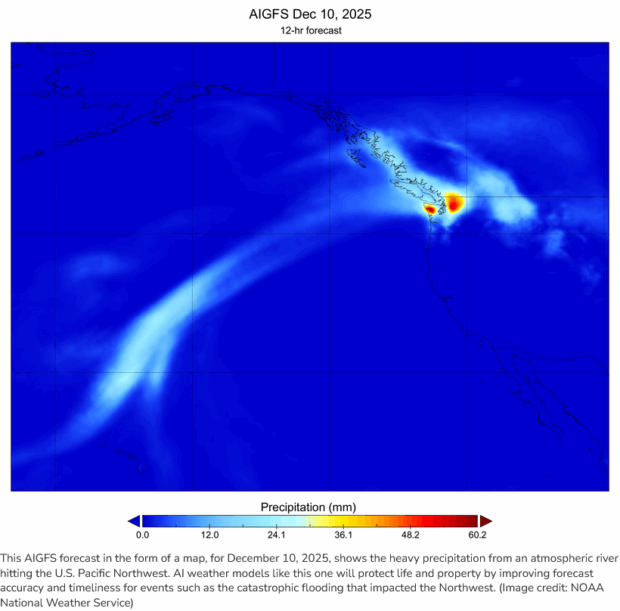 The new suite of AI weather models includes three distinct applications:
AIGFS (Artificial Intelligence Global Forecast System):
A weather forecast model that uses AI to source data to generate improved weather forecasts more quickly and efficiently. One 16-day forecast used just 0.3 percent of the computing resources of the operational GFS and finished in approximately 40 minutes.
This model demonstrated a significant reduction in tropical cyclone track errors at longer lead times, according to NOAA.
AIGEFS (Artificial Intelligence Global Ensemble Forecast System):
An AI-based 31-member ensemble system that provides a range of probable forecast outcomes.
Early results show improved performance over the traditional GEFS, extending forecasts by an additional 18 to 24 hours, while requiring only 9 percent of the computing resources of the operational GEFS.
HGEFS (Hybrid-GEFS):
A pioneering, hybrid “62-member grand ensemble” created by combining the 31 members of the physical GEFS with the 31 members of the AI-based AIGEFS.
Initial testing shows that this model, a first-of-its-kind approach for an operational weather center, consistently outperformed both the AI-only and physics-only ensemble systems.
This initial model suite is an outgrowth of Project EAGLE, a joint initiative between NOAA’s National Weather Service, Oceanic and Atmospheric Research labs, the Environmental Modeling Center in NOAA’s National Centers for Environmental Prediction, and the Earth Prediction Innovation Center.
“Using Project EAGLE and the Earth Prediction Innovation Center, NOAA scientists continue to work with members of academia and private industry on more advancements in forecasting technology,” Jacobs added.
The team leveraged Google DeepMind’s GraphCast model as an initial foundation and fine-tuned the model using NOAA’s own Global Data Assimilation System analyses. This additional training with NOAA data improved the Google model’s performance, particularly when using GFS-based initial conditions.
 When Builder’s Risk Coverage Doesn’t Reach the Finish Line
  Viewpoint: Six Questions Every CIO Should Ask Before Their Next AI Investment
  Workers’ Compensation’s Real Challenge: Orchestration
  The Impact of Claims Experiences on Trust