


















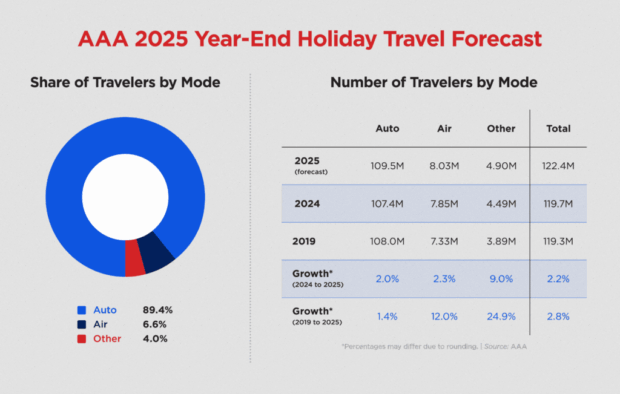
A record number of Americans are set to travel at least 50 miles from home over the 13-day year-end holiday period beginning December 20 and ending January 1, according to AAA projections.
An estimated 109.5 million Americans will travel by car for their year-end trips, a 2 percent increase compared to last year.
A record 8.03 million travelers will take domestic flights this holiday season, a 2.3 percent increase compared to last year.
This will be the first time on record that the number of domestic air travelers over the year-end holiday period exceeds 8 million, according to AAA data.
Travel by other modes is expected to rise by 9 percent, with 4.9 million people traveling by bus, train, or cruise. This category has seen a 25 percent increase since 2019, due to the record-setting demand for cruises post-pandemic.
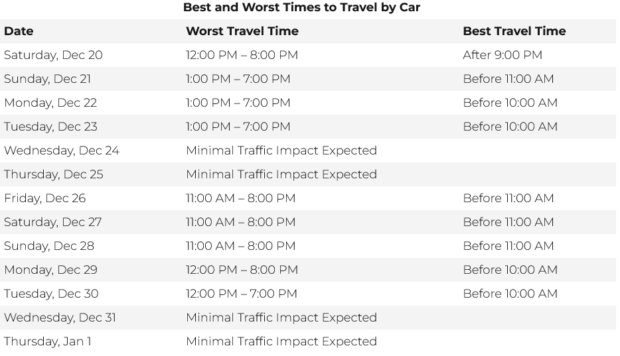
Best/Worst Times to Drive and Peak Congestion by Metro
Transportation data and insights provider INRIX expects Christmas week to be busier on the roads than New Year’s week, but both weeks will see days of increased traffic.
Interstates will be extra congested the weekend before Christmas, as travelers hit the road on Saturday and Sunday ahead of the holiday.
Friday, December 26, is also expected to be busy as travelers make moves post-Christmas Day.
Because the year-end holiday travel period spans a longer time frame, travelers have more options for departures and returns.
The holidays themselves – Christmas and New Year’s Day – are typically the lightest traffic-wise.
Please note the times listed below are for the time zone in which the metro is located. For example, Atlanta routes = ET and Los Angeles routes = PT.
 Why Your Boss Matters More Than Remote or Hybrid Work When It Comes to Burnout and Job Satisfaction
  The Latest Launches From The Zebra, Sigo Seguros, Applied Systems
  Highway Safety Agency Plans to Revise Outdated Vehicle Lighting Rules
  Most Americans Think AI Is Developing Too Fast: Poll