

















The National Flood Insurance Program (NFIP) is going broke. Increased flood strikes in more places, combined with outdated ways of predicting flood risk, are putting property owners at risk and the program itself in over $20 billion of debt.
Arizona State University researcher Upmanu Lall was part of a team that recently published a pair of papers to understand what is happening and what needs to be done. Adam Nayak, a PhD student at Columbia University, was the lead author of the studies.
Why this research matters
In the first study, the researchers looked at the impact of prolonged, large-scale weather events that cause flood damage across a region. They termed this pattern “hyperclustering” and found it to be the largest driver of national flood insurance debt.
In the second study, they analyzed millions of insurance claims, disaster aid records and property buyouts. They uncovered that most flood losses in the U.S. are linked to more commonplace rainfall events that happen once every 5 to 20 years.
Based on their findings, Lall and his colleagues argue for creating regional catastrophe bonds or secondary insurance to specifically handle hyperclustered events. They also suggest updating how we assess flood risk by including climate trends, population growth in floodplains and infrastructure decay into insurance models.
Their recommendations aim to keep the NFIP solvent, get flood damage victims meaningful financial assistance and improve flood safety.
How did we get here?
Since 1968, flood insurance has been subsidized by the federal government through the National Flood Insurance Program. Anyone living in a 100-year floodplain — defined as an area with a 1% annual chance of experiencing a flood — must carry flood insurance if they want a mortgage.
Financial losses due to storms and flooding — some costing billions of dollars — have been rising in the U.S. The eight largest national flood insurance payouts occurred in the last 21 years. This has put a huge strain on the NFIP, and the program owes more than it can pay.
“As one looks at future climate projections, migration trends within the U.S. and locations of new home developments, the problem is expected to get much worse,” Lall says. He is the director of the ASU Water Institute in the Julie Ann Wrigley Global Futures Laboratory and a professor in the School of Complex Adaptive Systems.
The problem with the ‘100-year flood’
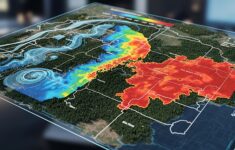
The Federal Emergency Management Agency (FEMA) develops 100-year flood zone maps based on historical data of river and coastal flooding.
However, a home in a 100-year flood zone could be flooded every single year. The zone’s boundary extends to an area with a 1% yearly risk of flooding, but properties further inside the boundary have much higher risks.
“This is why it is not surprising that we found that most of the insurance payoffs occur every 5 to 10 years, or put another way, with an annual flood probability of 10% to 20%,” Lall says.
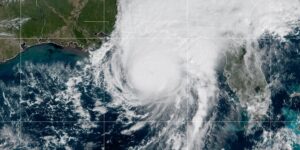
The team also found that the NFIP debt is largely driven by a rise in hyperclustered weather events. Hurricanes and storms that last weeks can bring flood damage to buildings across large regions. This type of event leads to many people submitting flood insurance claims at once — overwhelming the NFIP.
To truly be effective, the researchers argue, FEMA’s flood risk maps need to take more information into account, like population growth in flood-prone areas, aging infrastructure and modern weather trends. Models that bring in more context could make insurance more effective and help home builders and buyers act with safety in mind.
But we also need changes to the way flood insurance works.
Modern floods require modern insurance
Some have suggested replacing the NFIP with separate state programs. While this would benefit states where floods are rare, the authors argue that it would make flood insurance very hard to afford in more flood-prone states, which would need huge cash reserves to pay out claims. State programs could also face insolvency even sooner than the national program since they don’t spread risk across as large an area.
The researchers propose creating a multistate catastrophe bond that would distribute funds—and risk—across member states that need to supplement their state flood insurance programs.
“This would help price the risks more appropriately but also pool the risks so that the liquidity issues are dealt with,” Lall says.
The team also recommends looking beyond homeowners insurance and collectively examining all sources of financial risk reduction — like property buyouts, disaster declarations, insurance subsidies and private-market catastrophe bonds. This would help economists and policymakers optimize finances and reduce long-term risks.
“We need a redesign of the NFIP, disaster declaration funding and buyout programs, in conjunction with state- and community-level cofunding and private market catastrophe bonds,” Lall says. “Aggregation of risk is important at all levels to ensure better pricing and liquidity.”
About the study
Lall’s work was supported in part by the Institute for Geospatial Understanding through an Integrative Discovery Environment (I-GUIDE), which is funded by the National Science Foundation (award number 2118329). Nayak was supported by a National Science Foundation Graduate Research Fellowship.
The School of Complex Adaptive Systems is a unit of the Rob Walton College of Global Futures.
Source: Arizona State University
Reported by Mikala Kass, Senior Communications Specialist, ASU Knowledge Enterprise
 Viewpoint: The One Thing Holding Back Insurers’ AI Efforts
  Federal Bill Seeks to Reduce Work Week to 32 Hours
  Levers and Guardrails: How Growth Is Being Built at Hippo
  Push to End U.S. Changing Clocks Hits Dead End