















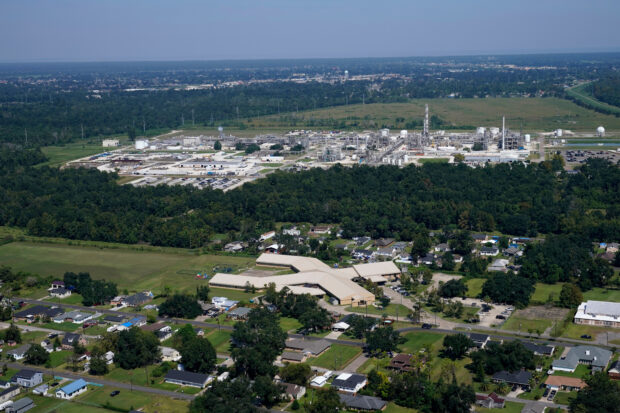
If heat-trapping pollution from burning coal, oil, and gas continues unchecked, thousands of hazardous sites across the United States risk being flooded from sea level rise by the turn of the century, posing serious health risks to nearby communities, according to a new study.
Researchers identified 5,500 sites that store, emit, or handle sewage, trash, oil, gas, and other hazards that could face coastal flooding by 2100, with much of the risk already locked in due to past emissions. But more than half the sites are projected to face flood risk much sooner — as soon as 2050. Low-income communities of color and other marginalized groups are the most at risk.
With even moderate reductions to planet-warming emissions, researchers also determined that roughly 300 fewer sites would be at risk by the end of the century.
“Our goal with this analysis was to try to get ahead of the problem by looking far out into the future,” said Lara J. Cushing, associate professor in the Department of Environmental Health Sciences at the University of California, Los Angeles, who co-authored the paper published in the science journal Nature Communications.
“We do have time to respond and try to mitigate the risks and also increase resilience,” she added, speaking at a media briefing on Wednesday ahead of the study’s release. The Environmental Protection Agency funded the study and built on previous research from California.
Climate change is driving and accelerating sea level rise. Glaciers and ice sheets are melting, and the sea’s waters are expanding as they warm. In many places along the coastal U.S., sea level rise is accelerating faster than the global average because of things like erosion and land sinking from groundwater pumping, according to the National Oceanic and Atmospheric Administration.
Thomas Chandler, managing director at the National Center for Disaster Preparedness at Columbia University, who was not involved in the research, said it’s “a really important study” that the public, policy makers, and government agencies “need to make note of.”
Derek Van Berkel, an associate professor in the school for environment and sustainability at the University of Michigan, who was also not involved in the study, wasn’t surprised to learn about the disproportionate risks. What was “alarming” was considering the magnitude of “feedback effects” from flooding, he said.
How researchers approached the data
The study’s researchers started by identifying and classifying tens of thousands of hazardous sites near the coasts of Puerto Rico and the 23 states with coastline. Next, they wanted to know each site’s projected future flood risk. They achieved this by calculating the likelihood of coastal flooding inundating a site each year, using historical sea level measurements and projected sea level rise in 2050 and 2100 under low and high emissions scenarios. Lastly, they identified and classified communities as being at-risk if homes are located within 1 kilometer (0.62 miles) of a hazardous site with a high threat of future flooding, and compared those communities’ characteristics with other coastal neighborhoods with no at-risk sites nearby.
But researchers did not include all types of hazardous facilities, such as oil and gas pipelines, nor did they account for groundwater upwelling or more intense and frequent storms in the future, which could lead to underestimates. On the other hand, the flood-risk model they used could have overestimated the number of threatened sites.
“It is important to note that previous disasters, such as hurricanes Katrina, Rita, and Harvey, did result in a lot of toxic contamination from oil and gas pipelines,” Chandler said.
The 5,500 at-risk sites include 44 percent that are fossil fuel ports and terminals, 30 percent power plants, 24 percent refineries, and 22 percent coastal sewage treatment facilities. Most of the sites — nearly 80 percent — are in Louisiana, Florida, New Jersey, Texas, California, New York, and Massachusetts.
Potential health impacts from exposure to hazards
People exposed to flood waters near industrial animal farms or sewage treatment plants could be exposed to bacteria like E. coli, said Sacoby Wilson, professor of global, environmental, and occupational health at the University of Maryland, during the briefing. Symptoms can include bloody or watery diarrhea, severe stomach cramps or vomiting, and fever.
Those living near industrial sites like refineries could be exposed to heavy metals and chemicals that can cause rashes, burning of the eyes, nose, and throat, headaches, or fatigue, added Wilson, who was not involved in the study. “For folks who are vulnerable, maybe have an underlying health condition, those health conditions could be exacerbated during those flood events.”
Longer term, some of these exposures could contribute to cancer, liver, kidney, or other organ damage, or have reproductive effects, he said.
For Chandler, the Columbia University director, the study highlights the need to heavily invest in hazard mitigation. “It’s really important for federal, state, and local governments in the United States to address these factors through multi-stakeholder resilience planning and encouraging local governments to integrate climate risk assessments into their mitigation strategies.”
The Associated Press receives support from the Walton Family Foundation for coverage of water and environmental policy. The AP is solely responsible for all content.
 Push to End U.S. Changing Clocks Hits Dead End
  The Latest Launches From The Zebra, Sigo Seguros, Applied Systems
  Nearly 50,000 Cars Damaged by Floods This Year: CARFAX
  Most Americans Think AI Is Developing Too Fast: Poll