

















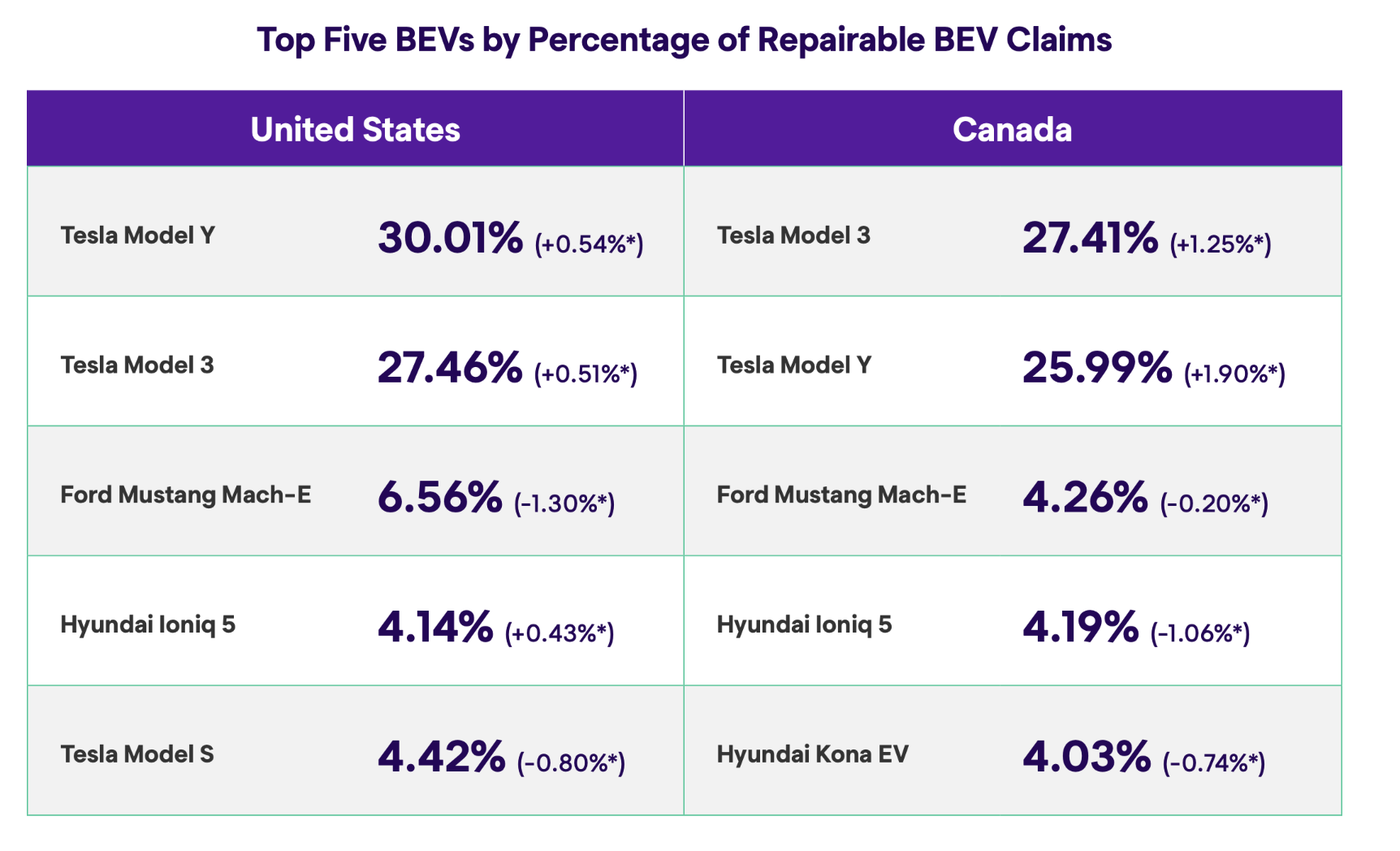
The number of battery electric vehicle claims in the U.S. dropped for the first time in the second quarter by 7 percent, coinciding with a 6 percent year-over-year reduction in new BEV purchases, a new report shows.
The report from Mitchell also shows claims for mild hybrid electric vehicle continue to rise. Claims frequencies for repairable mild hybrids, which rely on a small electric motor to assist the gasoline engine, reached roughly 5 percent in the U.S. and 4 percent in Canada, a jump of 2 percent and 9 percent respectively over the previous quarter and 21 percent and 29 percent over the previous year.
Comparatively, claims frequency for repairable, collision-damaged BEVs was 2.9 percent in the second quarter.
Mitchell’s latest Plugged-In: EV Collision Insights report for the second quarter examines the decrease in collision claims frequency for repairable battery BEVs in the U.S. and increase in MHEV claims across North America. It also explores how changes to government incentive programs are impacting consumer adoption of BEVs on both sides of the border.
The report’s authors say that with U.S. federal tax incentives set to expire in September and a proposal from the Environmental Protection Agency to repeal current greenhouse gas emission regulations, consumer demand for BEVs is being tested.
Auto manufacturers expanded BEV pricing discounts, which reached an all-time high of nearly $8,500 per vehicle in the second quarter, in an effort to boost sales.
Other findings in the report include:
- Total loss market values were stable, averaging $30,172 for BEVs and $13,850 for automobiles with an internal combustion engine. That’s a decrease of 2 percent and less than 1 percent respectively over the first quarter. Plug-in hybrid electric vehicles (PHEVs) also experienced a 3 percent decline in average total loss market value while MHEVs increased in value by close to 2 percent.
- Average severity for repairable automobiles remains the highest for BEVs at $5,903 in the U.S. and $6,633 (CAD) in Canada. PHEVs were second at $5,254 and $5,916 (CAD), respectively, followed by gasoline-powered vehicles in the U.S. ($4,938) and mild hybrids in Canada ($5,742 CAD).
- Although the percentage of parts repaired on BEVs rose slightly over the previous quarter (12 percent), that still fell short of ICE automobiles (14 percent). OEM parts remain more frequently used in BEV repairs with 83 percent of the parts dollars on estimates for repairable vehicles designated for OEM parts versus 63 percent for ICE alternatives.
Despite the slowdown in BEV sales, the report holds an optimistic outlook for BEVs.
“Even with the market headwinds, there are more BEVs on the road today than ever before and many organizations are still betting on the long-term growth of electric propulsion,” the report states. “For example, Panasonic recently opened a $4 billion lithium-ion battery plant in De Soto, Kansas and plans to employ 4,000 workers by the end of 2026. The company also began mass production of 2170 cells at a second North American facility with the goal of establishing annual production capacity of nearly 32 GWh in the future.”
A version of this article was previously published by Claims Journal.
 FEMA’s New Flood Maps Mean More Homes Require Flood Insurance: Cotality
  AI Data Center Boom: Understanding How Risks Are Changing
  Viewpoint: Insurers Are Automating the Front Office While Ignoring the Function That Determines Trust
  Weather Damage Turning Into Long-term Debt for Homeowners: Report