















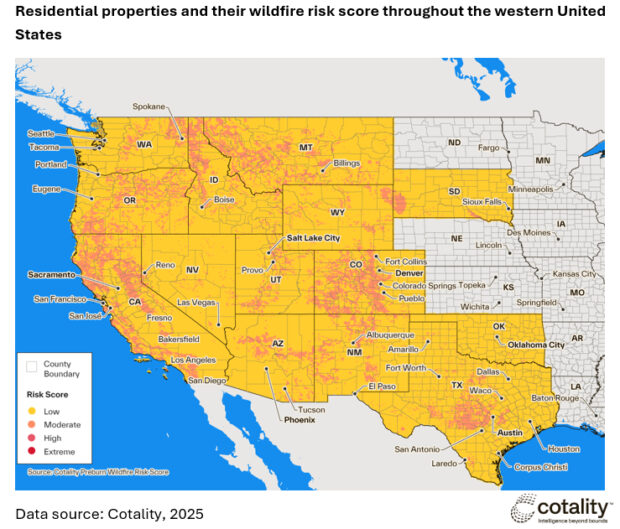
The once so-called “wildfire season” is now an ever-present threat, according to a new report published by global property data and analytics-driven provider Cotality.
It’s 2025 wildfire risk report, “Priced Out & Burned Out,” finds that more than 2.6 million homes in the Western United States, representing a combined reconstruction cost value of $1.3 trillion, face moderate or greater risk of wildfires, with more than one million of those homes facing very high risk.
Spread across 14 states in the Western United States, nearly half of the homes are in California (1.3 million), with Colorado (319,000), Texas (243,000), Oregon (128,000), and Arizona (124,000) rounding out the top five states with the largest number of homes at risk. 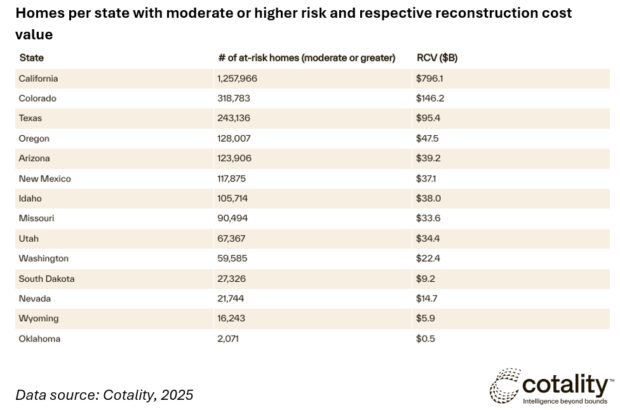
These states contain a high number of homes in the Wildland-Urban Interface (WUI) where there is elevated risk due to their proximity to forested or undeveloped areas.
“Wildfires are complex, fast-moving, dangerous—and a growing threat to homes and communities. Understanding the level of risk will help equip homeowners and insurers to take preventative action that can save properties and lives,” said Tom Larsen, Cotality’s AVP of Product Marketing for Insurance Solutions. “There are many contributing factors to the increasing threat of wildfires, including where and how we build. Building with wildfires in mind and introducing mitigation measures for where we have already built is one of the critical conversations we need to be having right now.”
California is home to eight of the top 15 metro areas with the most homes at moderate or greater wildfire risk – but wildfire threat isn’t just a problem in the Golden State.
Metros like Austin, Denver, and Colorado Springs are also facing elevated risks.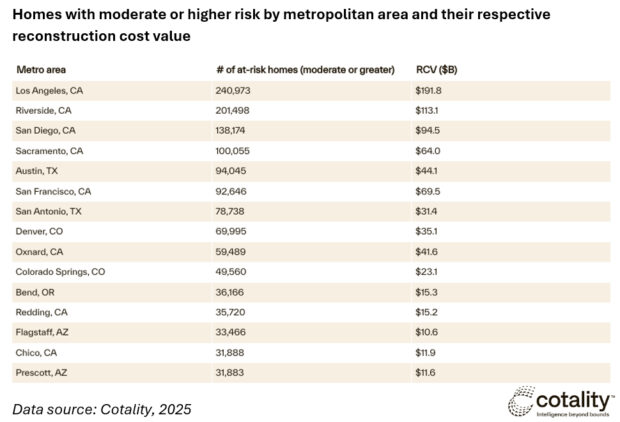
Wildfire behavior is shifting due to multiple factors, including fuel buildup from decades of fire suppression, expanding development into the WUI driven by population growth, and longer, drier seasons, the report noted.
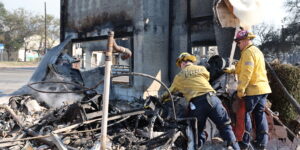
Cotality analyzed the complexities of wildfires like the Palisades and Eaton fires that occurred in January 2025.
Though both wildfires ignited as conventional wildfires, they transitioned into wildfire-induced conflagration once the fuel shifted from vegetation to homes and businesses, the report stated.
“The conflagration shift dramatically alters how fires spread and magnifies potential destruction that can occur,” the report added.
Since 2020, wildfire-induced conflagrations have destroyed more than 26,000 structures across the country.
For a deeper dive on the recent conflagration analysis, join Cotality Insurance Solutions for a webinar on August 26 at 12 p.m. ET.
 Most Americans Think AI Is Developing Too Fast: Poll
  Friend of Suspected FBI Data Thief Warned Teen Not to Hack Bureau
  Viewpoint: The One Thing Holding Back Insurers’ AI Efforts
  Why Your Boss Matters More Than Remote or Hybrid Work When It Comes to Burnout and Job Satisfaction