
















Stand Insurance’s goal is to say yes to almost anyone.
In January, about a month after the surplus-lines broker launched, Dan Preston, Stand’s co-founder and CEO, told Carrier Management that the startup had already felt demand across California and the United States.
The company’s residential policyholders are currently purposefully spaced throughout the Golden State. Stand covers up to $2 million in Coverage A and $10 million in TIV. Leadership expects those numbers to grow—and hopes to branch out to commercial properties in the future.
“We can look at almost any home, but typically, these are going to be the ones that have trouble finding admitted insurance,” Preston said, “and will be in places where there’s wildfire-based risk.”
He believes that California can be insured for less than what the risk is valued today.
“You just need to work with homeowners to make targeted changes that allow you to reduce the risk, and then, we can ultimately be able to offer better and better prices over time,” Preston said.
Stand’s Business Model
Stand currently focuses on personal property coverage that falls outside of the California FAIR Plan, which covers up to about $3 million for residential policyholders. Over the life of the business, Stand’s leaders “intend to incentivize billions of dollars of resiliency infrastructure globally, while making a substantial dent in the cost and availability of insurance,” according to the InsurTech’s website.
The core challenge with underwriting this type of business is that the last 10 to 15 years of wildfire risk data “is not telling us much about the next 10 years,” Preston explained. “And in a world in which these dynamics are changing so rapidly—and they’re reaching places they hadn’t before and happening at different rates—it’s very hard to select which risks you would like to underwrite. Or it’s very hard to price it differently based on that.”
He said that this has caused a huge amount of distress in markets like California, Florida, Texas and Colorado. Stand leadership’s belief is that “you can’t just cherry-pick the best risks,” Preston added, explaining that the only way to solve the problem is to focus on the physical resilience of structures and properties.
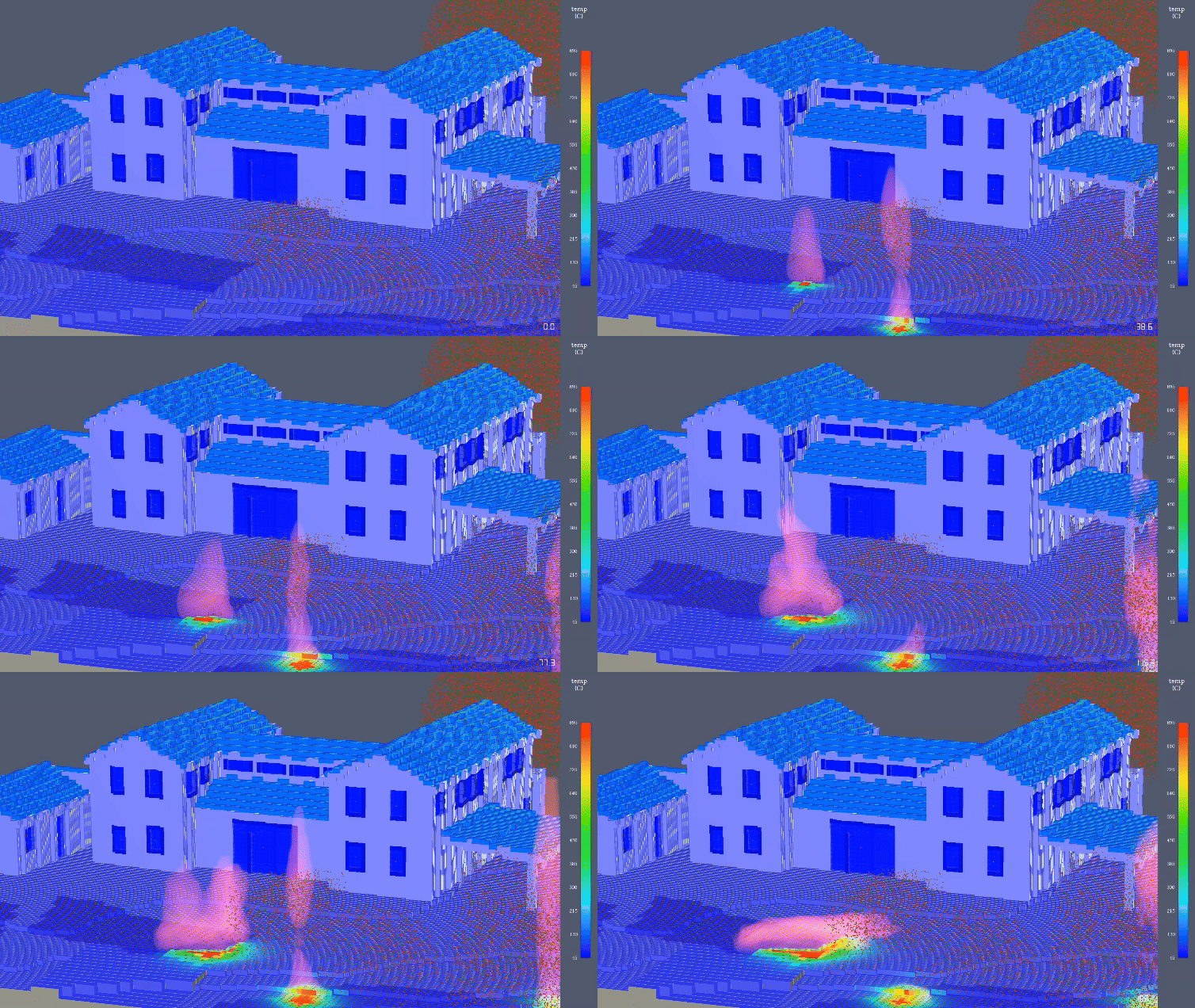
Stand specializes in determining what will lead to losses by tapping into fluid, dynamic models that simulate wildfire and wind events with digital twins. From there, Stand partners with policyholders to help them directly mitigate factors that could lead to losses.
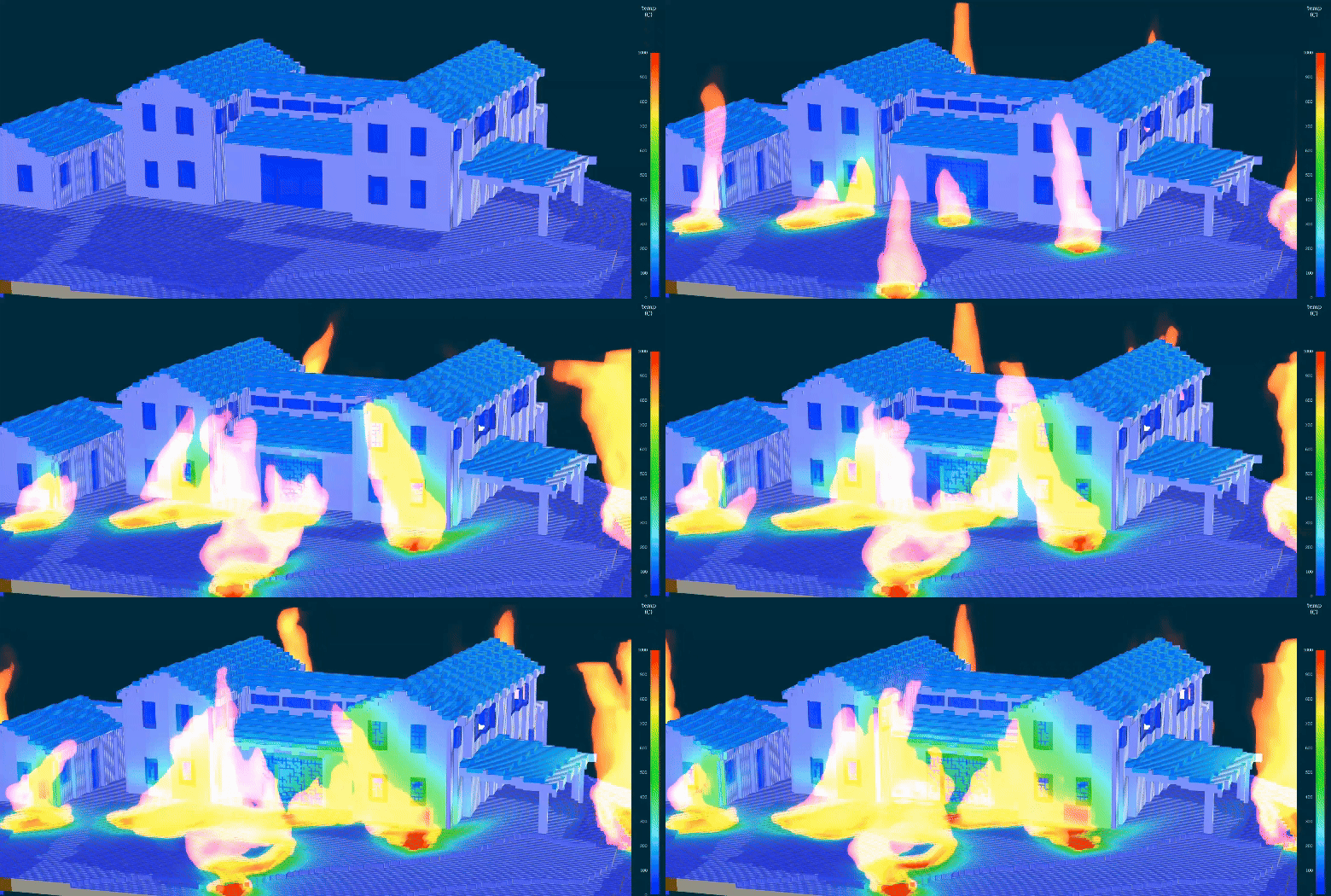
“This doesn’t just change the risk by 5 [or] 10 percent based on a climate model,” Preston said. “This could dramatically change the risk of the property being lost. From whatever it is today, to maybe 90 percent less.”
What Makes Stand Different?
Preston’s background is in computer science and machine learning. He was the CEO of per-mile auto insurance startup Metromile from 2014 to 2022. He then worked as Lemonade’s senior vice president of strategic initiatives for a year after the company acquired Metromile.
The idea that insurance companies and their insureds are highly aligned at avoiding the thing they’re insuring against is something that has excited Preston throughout his insurance career. It’s rare to find insurers that help policyholders avoid those risks, he said, noting that “there really isn’t an example of this in most lines of insurance, and certainly not … for property cat.”

“The unlock for us is that these simulations actually give us a forward-looking view as opposed to looking backward.”
Dan Preston, Stand Insurance
What’s stopping a policyholder from switching insurers after one company helped them mitigate risk? Also, for the most part, actuarial science rewards understanding historical data to look at cohorts and price accurately, Preston said. When you don’t have good history, it’s hard to build mitigation into your economic model, he added.
“The unlock for us is that these simulations actually give us a forward-looking view as opposed to looking backward,” Preston said. “The way that we’re validating this is through true physical-based models as opposed to saying, ‘Hey, we’re going to run a simulation and then back-test that.'”
Preston believes that other wildfire-centric insurance businesses that use sophisticated models to understand where risk is located and precisely price and build a profitable portfolio are doing important work in the wildfire risk space. Stand is focused on the properties that those other companies “will probably not want to underwrite,” he added.
Still, Stand isn’t going for “the most extreme examples in California yet,” Preston said.
Increasing Resiliency Through Modeling
Outside of the top 1 percent of riskiest areas and where the distance to a neighboring home is just too low, Stand can produce a resiliency plan for almost everyone, Preston explained. Most of the time, that translates to a few thousand dollars in changes.
It becomes a question of the openness of the homeowner to making what Stand determines are important property changes, Preston said, but he added that the company focuses on identifying changes that protect aesthetics. Increased resiliency can easily be achieved by cutting down all trees and vegetation within a 200-foot radius of a home, for example, but aesthetics can be important to homeowners.
“What we do is we basically say, ‘Alright, if these are the things you love, let’s figure out what else we can do to make it resilient,'” Preston said. “And that’s where these models end up helping us a ton.”
Potential clients are given an initial quote within two hours of contacting a Stand-appointed broker. The parties then discuss what the customer values on their property, and a visual simulation is run to help determine and show what may need to change to bolster property protection.
For example, Stand’s models show how close vegetation can safely be located to a home if a property has or does not have tempered glass windows installed. The models can also show, depending on materials used, how likely it is that a deck, porch or pergola would ignite from embers or radiant heat. Stand subjects all homes to basic structural requirements, such as using 1/16-inch vents to ensure embers cannot fly through and Class A roofs to deter ignition.
“One of the challenges with wildfire, in particular, is that it’s oftentimes a single point of failure,” Preston said. “So, you really need to have a comprehensive view. And then if people do want to keep certain components of that home, you really want to understand the nuances of what’s possible.”
The Key to Insuring and Underwriting in High Wildfire Risk Areas
“It’s centered on resiliency,” Preston said, “and making sure we do our best-in-class standard underwriting as well. You have to marry both worlds. If you want to be successful, you can’t just do resiliency. You have to also be really thoughtful about your core underwriting. That’s why we have folks who have 30, 40 years of experience in the space.”
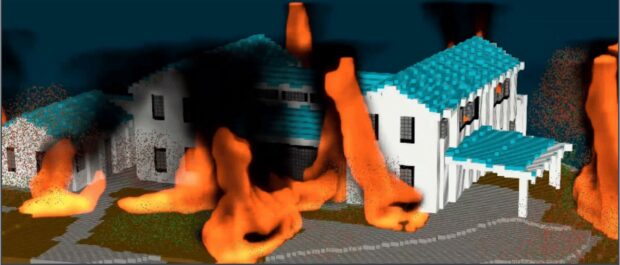
Images: Simulation graphics provided by Stand Insurance. Top featured image shows unmitigated property.
 After $240M Bitcoin Theft, Crypto Scammers’ Spending Spree Comes to an End
  Exiting California’s FAIR Plan
  Anthropic Researchers’ Dire Safety Warnings Prompt Call for New AI Rules
  How Leading Voices Can Help Claims Organizations Leap Ahead