













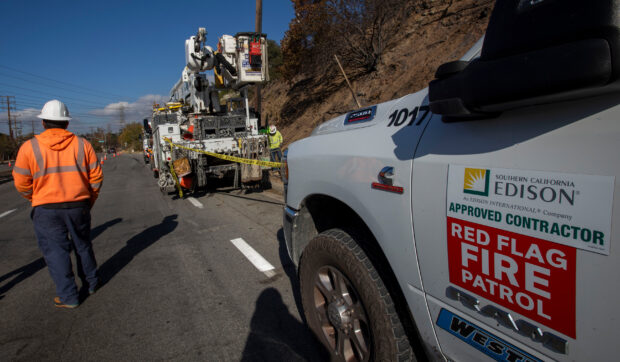
Insurance companies lost a bid to hold Edison International’s Southern California utility liable for a massive Los Angeles-area wildfire without a trial.
Superior Court Judge Laura Seigle on Tuesday tentatively denied a request to hold Southern California Edison on the hook for billions of dollars in property losses under a state law that holds utilities automatically liable when their equipment starts a fire.
The tentative ruling was debated by lawyers at a hearing just days after a report by the Los Angeles County Fire Department concluded the 2025 Eaton Fire was caused by electrical arcing events on an out-of-service tower on a dry hillside.
“We are pleased with the tentative ruling,” said SCE spokesperson Kathleen Dunleavy.
Edison’s shares rose on the news and closed up 3% in New York.
If the judge makes her tentative ruling final, Edison will get a chance to argue to a jury at a trial set for next year that the unusual circumstances around the ignition of the Eaton Fire do not qualify for inverse condemnation — the legal principle under which California property owners can recover their losses without having to prove that a utility acted recklessly.
The January 2025 fire killed 19 people, destroyed or damaged more than 9,000 homes and businesses, and burned 14,000 acres.
Edison Chief Executive Officer Pedro Pizarro told investors in late July that “no other viable alternatives have appeared” to explain how the wildfire erupted, aside from the company’s equipment.
But SCE has argued in court filings that the transmission tower where the Eaton Fire allegedly ignited had been idle since 1971; it no longer qualifies as the kind of public infrastructure that triggers California’s strict liability rule for utilities.
Lawyers suing Edison allege that a Jan. 7 power surge on a nearby, active line created a magnetic field that briefly re-energized the dormant cable, setting off the sparks that ignited the blaze.
Adam Romney, a lawyer for the insurers, argued during the hearing that it was “foreseeable” that the idle transmission tower could become re-energized.
But the judge found in her written ruling that the facts presented by plaintiffs “and underlying evidence do not establish that a wildfire is an inherent risk of SCE’s idle lines as a matter of law.”
Seigle told Romney, “You’re incorrect to say that inherent risk is part of substantial causation.”
“Both must be present for a public entity to be liable” under inverse condemnation, she said.
Bloomberg Intelligence analyst Holly Froum said a settlement of the multibillion-dollar litigation is likely.
“The tentative ruling gives SoCal some leverage, but given the evidence, a jury could also find the idle equipment posed an inherent risk,” she said.
Separately, Bloomberg Intelligence analyst Nikki Hsu said the tentative ruling “doesn’t address whether SCE acted prudently or not, which is ultimately a regulatory determination and the key issue for shareholder exposure.”
 Texas Reports Downward Trend in Home, Auto Insurance Rates
  Large Commercial Property Rates Drop 14.5% in Q2 to Highlight Latest Willis Report
  U.S. Power Use Expected to Reach Record Highs in 2026, 2027 as AI Surges
  Highway Safety Agency Plans to Revise Outdated Vehicle Lighting Rules