

















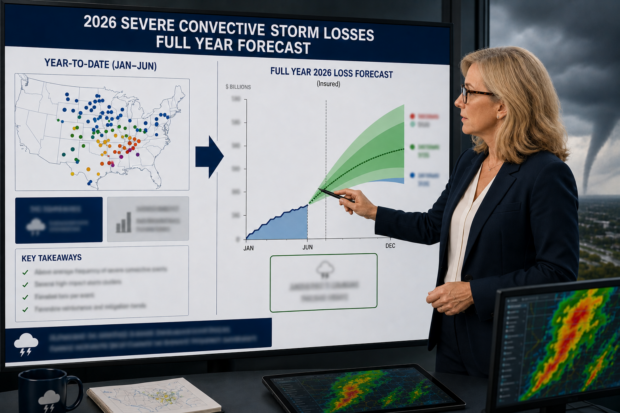
According to a bulletin published by KCC, the risk modeling firm projects that severe convective storm losses for all of 2026 will drop below annual averages based on loss activity accumulated so far for the first six months.
While losses by the end of June usually account for over 75 percent of total annual SCS losses, the typically high level of activity that occurs during the spring months—May, in particular—did not happen this year, according to KCC.
Separately, Aon reported a total of $27 billion in insured losses from U.S. severe convective storm events for the first half of 2026 vs. more than $40 billion for the same periods in the prior three years as part of the broker’s Global Catastrophe Recap for the first half of 2026.
KCC did not provide insured loss or economic loss figures for this year or prior years in its bulletin or when contacted by Carrier Management, instead noting that its modeled estimates for the total industry losses are confidential (available only to clients).
The text of the KCC bulletin notes that KCC’s SCS model provides insurers with daily hail and tornado/wind intensity footprints for ongoing estimates of claims and losses, and that industry losses are accumulated by day and event.
KCC’s SCS Bulletin, however, does highlight why insured losses this year are coming in below average compared to prior years. According to KCC, during a typical Spring, the jet stream—a significant driver of storm activity—is in a southerly position, giving rise to storms in the Southeast and Texas, where higher losses typically occur. This year, in contrast, “southerly storm tracks were blocked by a persistent high-pressure system,” the report says noting that this system sat over the Southeast for much of the month of May.
“High pressure often means warm, dry weather, and sinking air, which prevents convective storms from developing,” the bulletin explained, also noting that exceptionally dry weather in the Southeast is prolonging drought conditions in this region.
“This weather pattern led to above-average wildfire activity” in the Southeast, “but almost no severe storms for the entire month,” the bulletin said, adding that SCS impacts were mainly in the Central Plains.
For the full year, KCC believes 2026 SCS losses will be above average in the upper Midwest but lower than normal in Texas and the Southeast.
Lower Totals Mask Regional Impacts, Record-Breaking Tornadoes
For its part, Aon noted that the lower level of insured losses from U.S. SCS in the first half of 2026 reflected both “lower year-to date frequency across all three major sub-perils”—wind, hail, and tornado—”and a fragmented loss pattern in densely exposed regions.”
Still some states in the Midwest dealt with “extraordinary tornado activity”—breaking records on the high side, Aon reported, referencing repeated outbreaks across Iowa, Illinois, Indiana and surrounding states.
According to the Aon report, Illinois alone recorded 178 confirmed tornadoes by mid-year, roughly four times its long-run average. The report also refers to a sequence of EF2+ events in Illinois and Indiana in mid-March, tornadoes in Wisconsin in April and another Midwest SCS event from June 11-17.
Commenting on the hail and wind perils, Aon notes that a March 10-11 SCS outbreak over northern Illinois and Indiana brought “record-shattering hail near the Chicago metro region,” making it one of the highest loss events of the half-year. Another outbreak across eastern Iowa, southern Wisconsin and northern Illinois a month later included “softball-sized hail” in Madison, Wisc., and multiple tornadoes including one EF3, Aon said.
On a global scale, the report highlights below-average catastrophe losses similarly masking significant regional impacts during the first half of this year.
Overall, $47 billion of insured loss around the world was largely driven by U.S. severe convective storms, the report states. The costliest event for insurers was a U.S. SCS outbreak in late April producing $5.3 billion in insured losses.
A large component of economic losses—$20-30 billion—came from the Venezuela Earthquake on June 24, the costliest economic-loss event in the quarter.
As for how the overall numbers shake out compared to prior half-years:
- The $47 billion in global insured losses, while 4% higher than the average for the 21st century, was also the lowest level recorded since 2019.
- $111 billion in economic losses from catastrophes across the globe in the first half, was 25% below the century’s average—and the lowest economic loss amount recorded since 2018.
- 77% of global insured losses for all types of catastrophes were recorded in the U.S.
- In terms of economic losses, SCS was the costliest overall peril, contributing roughly $40 billion to the $111 billion global total.
- According to Aon, the $40 billion was a big drop from more than $60 billion of “record-breaking” economic damage tallied for SCS events globally for each of the three prior half-year periods.
In the U.S., while multiple SCS outbreaks exceeded $1 billion dollars in insured losses in first-half 2026, “the absence of outsized SCS loss events has kept overall losses trending below the recent cadence,” the Aon report says.
Still, Aon expects “outsized losses” this year for insurers with portfolios that are regionally concentrated in southern Wisconsin, eastern Iowa, northern Illinois and Indiana “whereas other SCS-exposed regions have witnessed a fragmented loss pattern.”
“H1 2026 has reinforced the familiar SCS paradox that tornado counts can be exceptional but insured losses depend on where and how those storms intersect with exposure.”
 Federal Bill Seeks to Reduce Work Week to 32 Hours
  The Impact of Claims Experiences on Trust
  Hawaii Likely Needs $1B in Disaster Recovery, Resilience Funds
  The Latest Launches from Orion180, Arbol, Zywave