













Wildfires and severe convective storms dominated North America’s natural catastrophe losses last year, according to a recent report from Swiss Re Institute. In the absence of a major U.S. hurricane landfall, these secondary perils made up 99.9% of 2025 insured natural catastrophe losses in the region.
North America recorded more than $90 billion in insured natural catastrophe losses in 2025, down from $117 billion in 2024 and below the five-year average of $97 billion. But the below-trend result does not signal a reduction in underlying risk, Swiss Re said.
Severe convective storms caused $46 billion in losses in North America, making 2025 the third-costliest year on record for that peril, Swiss Re said.
Insured losses from severe convective storms in North America have risen by 7% annually since 1970, according to the report. Swiss Re said the increase is largely explained by exposure growth, including rising asset values and expanding development in areas exposed to hail and flooding.
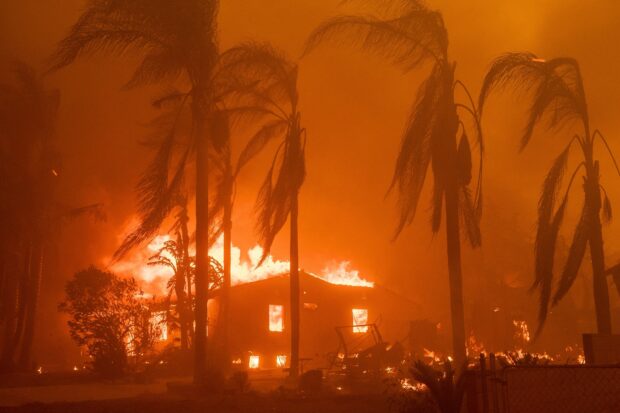
The largest loss-making disasters of the year in North America were the Palisades and Eaton wildfires in Los Angeles County, which combined resulted in insured losses of $40 billion—by far the largest global insured wildfire loss event on sigma records. Swiss Re said the losses were driven by the burning of some of the highest-value and most densely built wildland-urban interface (WUI) areas in the U.S.
Over the past 55 years, insured wildfire losses in North America have grown roughly twice as fast as exposure, Swiss Re said, reflecting a combination of expanding development in high-risk areas and changes in the underlying risk landscape.
“Wildfires have become one of the defining natural hazards shaping North America’s risk landscape,” said Jolee Crosby, CEO, Swiss Re Canada, in a statement. “While changing weather conditions are one part of the picture, growing exposure in wildfire-prone areas is equally important.”
“As more people and more valuable assets are located in wildfire-prone areas, resilience becomes just as important as recovery,” she said. “Insurance is there to help communities rebuild after disasters, but long-term resilience will depend on continued investment in mitigation, preparedness and smarter development.”
Photo: A home burns in the Eaton Fire in Altadena, Calif., Jan. 8, 2025. (AP Photo/Nic Coury, File)
 States Question Safety, Challenge FAA Review of Commercial Drone Delivery Rules
  US States Allege Corteva Spinoff a Bid to Evade PFAS Liabilities
  AM Best: US Home Insurers in 2025 Book First Underwriting Profit in Seven Years
  Men Sentenced in Multi-State Stolen Construction Equipment Scheme