



















Apple Inc.’s new chief executive officer joined the iPhone maker 25 years ago and was tapped for the top job at age 50. While that would have been a common trajectory for CEOs a generation ago, the typical path to power for business leaders is longer now, with more career twists and turns along the way.
The average American CEO is 61, a decade older than in 2000. Tenure length and delayed retirement are only part of the story. Executives are starting in the top job later in life than they used to. The average age at appointment is now 55 years old, up from just under 48 years old in 2000.
This graying of the corner office, shown in a National Bureau of Economic Research working paper that analyzed the hiring and career patterns of more than 50,500 CEOs in the US between 2000 and 2023, reflects “fundamental changes” in how executives build careers and how companies select their leaders, according to the study’s authors, with varied business experience favored over raw ability.
“Demand has shifted toward generalist skills,” said the researchers, Valentin Kecht and Farzad Saidi at the University of Bonn and Alessandro Lizzeri of Princeton University. “As executives require longer career paths to build such diverse capabilities, firms appoint older CEOs.”
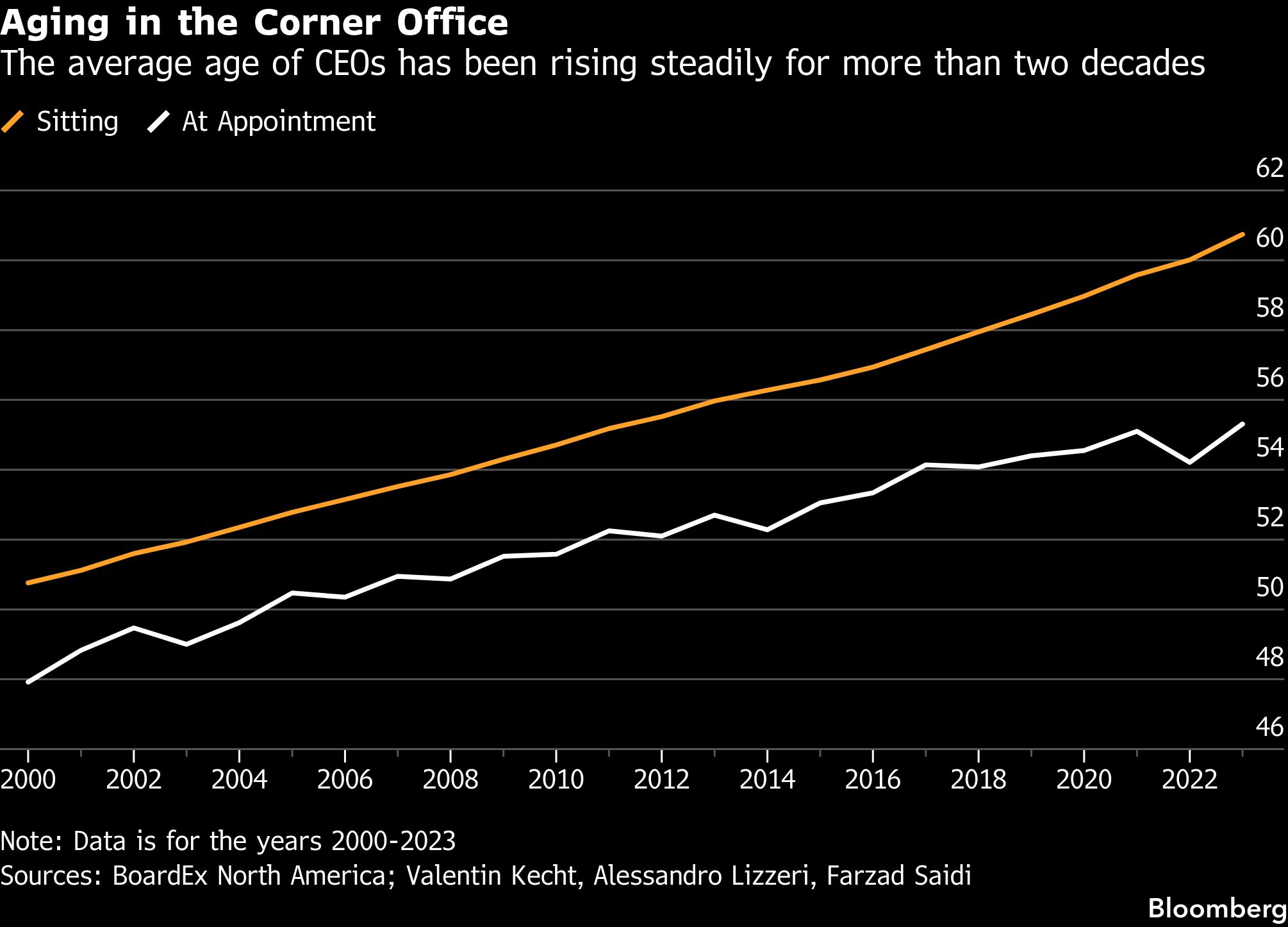
The trend is most pronounced among smaller, privately-held firms, the researchers said. That’s because larger companies can offer internal candidates a wider range of assignments, cultivating a well-roundedness that smaller companies “can only access by hiring executives who accumulated that experience by moving across many firms and industries.” (This also helps explain why the average age of CEOs at S&P 500 Index companies is below the average and not advancing as fast, rising from roughly 56 years old in 2000 to 58.5 in 2023.)
Executives with experience in the strategy consulting sector — which “fast-tracks the accumulation of generalist skills,” the researchers note — have grabbed a greater share of CEO roles, according to a separate analysis by Live Data Technologies for Bloomberg. In the NBER paper, the researchers found that people with experience at one of the top three strategy consulting firms (McKinsey & Co., Bain & Co. and Boston Consulting Group) tend to be appointed CEOs at “substantially” younger ages. Executives who rise up through other industries “take longer to acquire the same skills,” the researchers said.
To gain that well-roundedness, some leaders are willing to take a step down in pay or seniority for a role they suspect will make them a better CEO candidate down the road, according to the working paper, which has not yet been peer-reviewed. To determine that, the researchers studied what happened to employees who worked alongside someone who then became a CEO elsewhere. These executives were more likely to switch jobs, the researchers found.
“When someone in an executive’s network makes it to the top, they observe the career path that person took and update their beliefs about what it takes,” the study’s authors told Bloomberg via email. For example, a senior executive at a small biotech firm might move to a more junior role at a large pharmaceutical company, betting that the combination of the biotech and drug-company roles makes them a more attractive CEO candidate later on.
The analysis dovetails with other research showing that CEOs are getting older. Revelio Labs, which provides workforce intelligence, found a three-year increase in the average age of CEOs at the beginning of their tenure between 2018 and 2024. The researchers of the NBER paper relied in part on Revelio job-history data, but looked across a wider time frame, from 2000 to 2023. The beginning of that period coincided with the end of the dot-com era from which many young founder-CEOs emerged, like Amazon.com Inc.’s Jeff Bezos, who was in his mid-30s then. But the researchers said that there was no evidence supporting a “rebound effect” of CEOs getting older, on average, following the late 1990s tech boom.
The paper also addressed the business implications of having more sexagenarian CEOs, who tend to run firms that are slower-growing and less innovative. While concerning on one level, the researchers said, their more risk-averse approach might represent “a rational response to changing business environments characterized by heightened uncertainty and complexity.”
With more years of experience making hard calls, older executives might also be better able to seize the opportunities, cope with the ambiguities and ward off the commonplace job insecurities presented by artificial intelligence.
Seasoned leaders “who can effectively leverage these technologies may become more valuable,” the researchers told Bloomberg via email. Plus, their skills of “coordination, adaptation, and decision-making under uncertainty are also the kinds of skills that are likely difficult to codify and automate.”
 Levers and Guardrails: How Growth Is Being Built at Hippo
  The Impact of Claims Experiences on Trust
  The Latest Launches from Orion180, Arbol, Zywave
  Broad AI Exclusions in Insurance Policies Could Create Uncertainty, Marsh CEO Says