















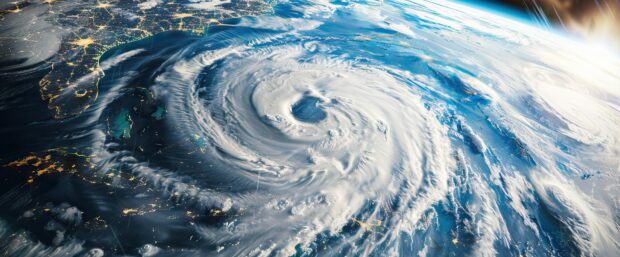
A 1-in-100-year hurricane event in New York City could cost insurers more than $100 billion, according to an analysis by Karen Clark & Co (KCC). And a 1-in-250-year hurricane could cost insurers twice as much, the catastrophe modeler says.
While New York does not face the same natural catastrophe exposure as areas such as Florida, the state is not immune to large losses. New York has nearly $9 trillion in insured property exposure—$6 trillion of it concentrated in coastal counties—which means even rare events can create outsized losses, KCC says in its newest white paper, New York Exposure to Natural Catastrophes.
KCC notes that 11 hurricanes have impacted New York since 1850—the most famous of these being the Great New England Hurricane of 1938.
The hurricane made landfall on Sept. 21, 1938, in Bellport, NY, as a Category 3 storm with estimated maximum sustained winds of 121 mph. The storm brought more than 15 feet of storm surge to Long Island and continued to track inland, causing damage well into Canada before transitioning to a post-tropical cyclone.
If the same storm occurred today, it would cause $20.5 billion in insured losses in New York alone, according to a KCC analysis.
If a similar category 3 hurricane were to make landfall near Rockaway Beach—which KCC says is the worst-case scenario for New York—the insured losses would be over $100 billion in New York and $200 billion overall.
Meanwhile, KCC says a lower probability event like a 1-in-250-year hurricane—a borderline category 3/4 storm—is expected to result in well over $200 billion in insured losses for New York and over $350 billion in total insured losses.
The KCC analysis also discusses the considerable risk New York faces from both severe convective storms and winter storms, which together generate almost $1 billion in average annual property losses in the state.
 Nearly 50,000 Cars Damaged by Floods This Year: CARFAX
  Delegation Without Abdication: A Division of Labor for Human-AI Decisions in Insurance
  Levers and Guardrails: How Growth Is Being Built at Hippo
  How a Kelvin Wave Is Raising the Sea Level Along the West Coast