



















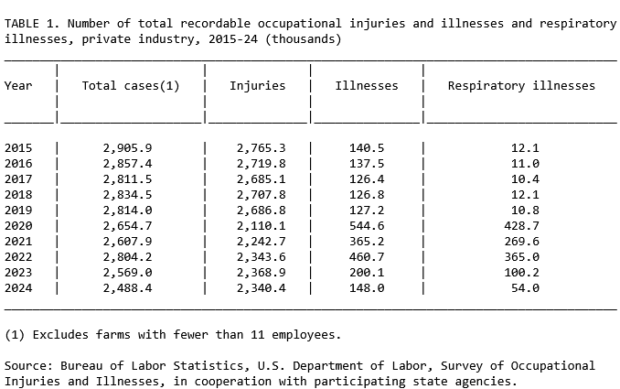
Private industry employers reported 2.5 million nonfatal workplace injuries and illnesses in 2024, down 3.1% from 2023, the U.S. Bureau of Labor Statistics reported last month.
It’s the lowest number of employer-reported injuries and illnesses dating back to 2003, driven by a 26.0% drop in illness cases to 148,000, due to a 46.1% decrease in respiratory illness cases to 54,000. It’s the lowest number of cases for each series reported since 2019.
The incidence rate of total recorded cases (TRC) in private industry was 2.3 cases per 100 full-time equivalent (FTE) workers, down from 2.4 cases in 2023.
The incidence rate of illnesses decreased in 2024 to 13.9 cases per 10,000 FTE workers, from 19.0 cases in 2023.
Respiratory illnesses occurred at a rate of 5.1 cases per 10,000 FTE workers in 2024, down from 9.5 cases in 2023.
In 2024, five industry sectors saw a reduction in the TRC incidence rate.
The information sector saw a decrease to 0.7 cases per 100 FTE workers in 2024, down from 1.0 cases in 2023.
The TRC rate in the health care and social assistance sector decreased to a rate of 3.4 cases per 100 FTE workers in 2024, down from 3.6 cases in 2023.
The retail trade, manufacturing, and real estate and rental and leasing sectors also saw decreases in their TRC rates in 2024.
No industry sector had a TRC rate increase in 2024, the report noted.
Over the 2-year 2023-2024 period, there were 1.8 million cases involving days away from work (DAFW) in private industry, representing 61.5% of the total cases involving days away from work, job restriction, or transfer (DART). These DAFW cases occurred at an annualized incidence rate of 86.6 cases per 10,000 FTE workers and resulted in a median of 8 days away from work.
Over the same period, there were 1.1 million cases involving days of job transfer or restriction (DJTR), which accounted for 38.5% of total DART cases and occurred at an annualized rate of 54.2 cases per 10,000 FTE workers. The median days of job transfer or restriction were 15 days over 2023-2024.
During the 2-year 2023-2024 period, the highest number of DART cases were caused by overexertion, repetitive motion, and bodily conditions at 946,290, followed by contact incidents with 860,050 cases.
Notably, 87.6% of the total exposure to harmful substances and environments cases (196,540 of the 224,450 total DART cases) required at least one day away from work.
The report is the first of two releases from BLS covering occupational safety and health statistics for the 2024 calendar year.
A second release on February 19, 2026, will provide results from the Census of Fatal Occupational Injuries (CFOI) of all fatal work injuries occurring in the U.S. during the calendar year.
 Most Americans Think AI Is Developing Too Fast: Poll
  Amazon Cargo Plane Pilots Weren’t Warned About Wind Before Miami Crash: NTSB
  Federal Bill Seeks to Reduce Work Week to 32 Hours
  Majority of Online Scam Campaigns Target Common Infrastructure: Study