



















The National Safety Council (NSC) has projected that 429 people may die on U.S. roads this New Year’s Day holiday period. The figure is slightly above the six-year average of 423 fatalities experienced over previous holidays of the same length.
The New Year’s Day holiday period varies from 1.25 to 4.25 days in length, depending on which day of the week the holiday falls.
In 2026, New Year’s Day falls on a Thursday, so the holiday period is 4.25 days and extends from 6 p.m. Wednesday, December 31, 2025, to 11:59 p.m. Sunday, January 4, 2026.
The 90 percent confidence interval for the estimate of traffic deaths this holiday ranges between 339 and 529.
This chart shows NSC New Year’s Day holiday fatality estimates and confidence intervals compared to the actual number of deaths.
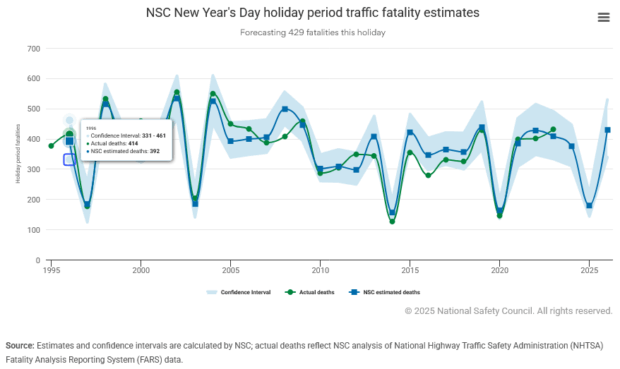
The latest final fatality data available are for 2023.
The NSC underestimated the actual number of New Year’s Day deaths in 2023 by 5.3 percent, falling within the confidence interval.
Based on the current medically consulted injury-to-death ratio of 114:1 and rounded to the nearest hundred, the estimate of nonfatal medically consulted injuries that will result from crashes during the holiday period is 48,900, with a 90 percent confidence interval of 38,600 to 60,300.
An estimated 153 lives may be saved this New Year’s Day holiday period because vehicle occupants wear their seat belts. An additional 109 lives could be saved if everyone used seatbelts, according to the safety agency.
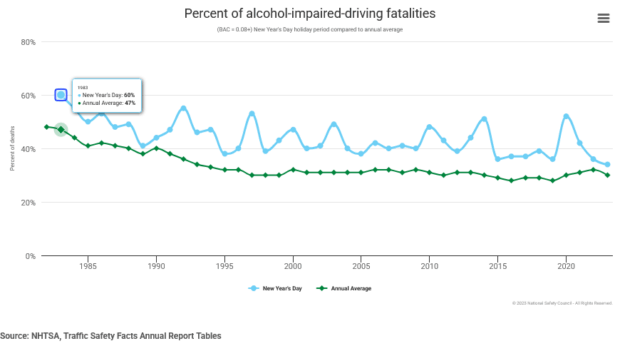
Nationwide, alcohol-impaired fatalities (involving blood-alcohol content of 0.08 g/dL or higher) in 2023 represented 30 percent of total traffic fatalities.
During the 2023 (latest available data) New Year’s Day holiday period, 34 percent of fatalities involved an alcohol-impaired driver.
This chart shows the historic trend of the percent of fatalities involving an alcohol-impaired driver.
 The Latest Launches from Soteris, CLARA, Cozmo AI
  Building Trusted Insurance Brands: How Nationwide Delivers Tangible Value to Customers
  Why Your Boss Matters More Than Remote or Hybrid Work When It Comes to Burnout and Job Satisfaction
  Lyft to Pay $272M to Settle California Rideshare Drivers’ Wage Theft Lawsuit