















While figures show a stabilizing theft landscape, high-value and ultra-high-value goods are increasingly targeted by organized crime rings, according to the Q3 report released by CargoNet.
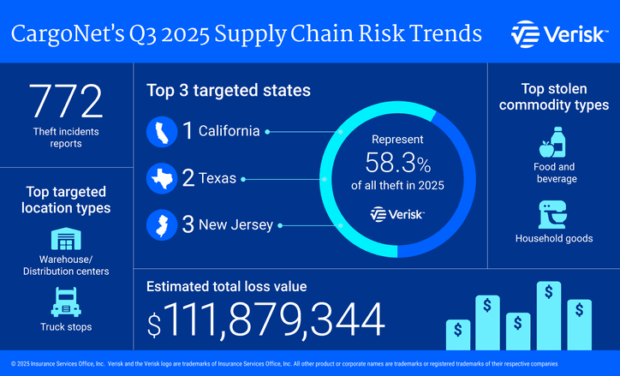
The cargo theft prevention and recovery arm of Verisk counted 772 cargo theft events across the United States and Canada in Q3 2025, a 1 percent increase compared to Q3 2024 and a 10 percent decrease from Q2 2025.
Though incident volume remained relatively stable, the financial impact surged to record levels.
The total value of stolen goods in Q3 2025 reached $111.88 million, driven by organized crime groups targeting high-value shipments of enterprise computer hardware, cryptocurrency mining equipment, and copper products.
The average stolen shipment value doubled to $336,787, up from $168,448 in Q3 2024.
Verisk reported that California and Texas, historically high-theft states, saw modest year-over-year increases of 11 percent and 12 percent, respectively.
The most dramatic shift in thefts occurred in the New York City metropolitan area, where New Jersey theft incidents surged 110 percent and Pennsylvania rose 33 percent.
“The NYC metro area is emerging as both a primary location for theft activity and a destination for stolen goods,” said Keith Lewis, VP of Operations at CargoNet. “Organized crime groups are exploiting the region’s dense logistics network and proximity to major consumer markets.”
Organized crime groups are adapting to anti-fraud tools deployed across the logistics industry, according to CargoNet’s analysis. “Behavioral shifts within these networks signal a recalibration that supply chain stakeholders must monitor closely,” the Verisk company added.
Some groups are abandoning complex schemes—such as proof-of-delivery fraud and authority takeovers—in favor of simpler, more direct thefts of unattended, loaded trailers, especially in Southern California, the Bay Area, Phoenix, and Lake Tahoe.
Other groups are refining fraud tactics to bypass security measures. They look to exploit a critical vulnerability, CargoNet reported, since most anti-fraud tools focus on the shipment tender phase. Using sophisticated social engineering, they gather intelligence on shipments already assigned to legitimate carriers. Once the carrier is identified, they impersonate company representatives to misdirect drivers.
Criminal networks are becoming increasingly sophisticated in their approach, with a particular focus on targeted information harvesting.
In Q3, CargoNet witnessed criminal groups leverage social engineering techniques to obtain granular shipment details like: the specific brokerage handling the shipment, the assigned motor carrier, and critically, the names and contact information of individual points of contact at both the brokerage and carrier level.
By using the correct names, company details, and shipment specifics, criminals established enough credibility to redirect shipments to fraudulent addresses without ever being tendered the shipment.
This tactic is expected to continue through Q4 2025.
Q3 saw dramatic increases in theft of specific commodities:
Meat and seafood products: Rose by 189 percent from 18 events in Q3 2024 to 52 events in Q3 2025
Copper: Nearly 5x growth (10 -> 47 events)
CargoNet also documented significant targeting of enterprise servers, components, and cryptocurrency mining hardware—shipments valued in the millions yet transported as standard dry goods, making them highly vulnerable.
Food and beverage commodities led all categories with 170 theft events, followed by household goods (92) and metals (65). There was also a modest uptick in thefts of games and toys, likely due to the approaching holidays.
“As criminal tactics evolve, so must our collective defense,” said Lewis. “The supply chain security challenge requires industry-wide collaboration, enhanced information sharing protocols, and a commitment to staying ahead of emerging threats.”
 Federal Bill Seeks to Reduce Work Week to 32 Hours
  US States Allege Corteva Spinoff a Bid to Evade PFAS Liabilities
  AI Data Center Boom: Understanding How Risks Are Changing
  Levers and Guardrails: How Growth Is Being Built at Hippo