

















Early AI initiatives in personal auto have largely focused on improving efficiency within individual functions, from claims and customer service to underwriting automation.
A new model is emerging.
Leading insurers are connecting AI, predictive analytics, workflow automation, and behavioral intelligence into a continuous decision ecosystem spanning acquisition, underwriting, servicing, and retention. The result is an insurance lifecycle that learns, adapts, and becomes more intelligent with every customer interaction.
Over time, this may prove to be one of the industry’s most powerful competitive differentiators. As AI accelerates innovation cycles, the gap between market leaders and followers could widen dramatically.
Moving AI upstream
The greatest opportunity may lie earlier in the customer journey.
AI has the potential to transform decision-making at Rate Call 1, enabling insurers to personalize acquisition strategies in real time. By combining AI with Verisk’s Coverage Verifier Analytic Objects (CVAO), insurers can uncover high-value opportunities that traditional approaches often miss and turn emerging market dynamics into profitable growth.
- Goal: Identify and win business from consumers who exhibit stronger loyalty, retention, and long-term value.
- Challenge: Traditional indicators of loyalty, such as years with the most recent carrier, have become less effective in an increasingly dynamic shopping environment. Yet consumers with historically stronger retention characteristics often continue to deliver superior loss and profitability outcomes compared to serial shoppers.
- Solution: An AI-powered decision network overlaying CVAO insights at Rate Call 1 can help identify applicants with higher retention and lifetime value potential, price them more strategically, and segment risks with greater precision.
The result is smarter acquisition, improved portfolio quality, and a scalable competitive advantage.
A new source of competitive advantage when harnessing AI: Behavioral intelligence
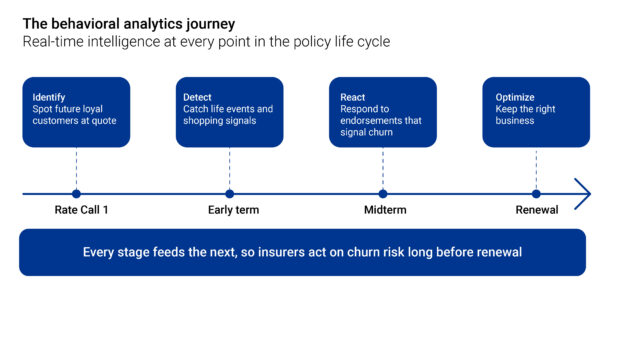
While insurers have traditionally focused on transactional events such as quoting and renewal, behavioral intelligence is creating visibility into what happens between those moments.
Life events, policy changes, household shifts, vehicle additions, and other activities often reveal changing customer needs long before a shopping or renewal decision arrives. Behavioral signals can provide valuable context about evolving risk, retention potential, and customer engagement opportunities.
For AI systems, these signals become actionable intelligence across the policy lifecycle.
From renewal events to continuous retention
Customer behavior is evolving faster than traditional retention strategies can keep pace.
According to Verisk’s 2026 Personal Auto Insurance Retention Report, insurers experienced a 3.2% decline in retention in 2024. Yet most retention programs remain anchored to renewal, even though many shopping decisions now occur weeks or months before a renewal offer is ever sent.
AI changes that equation.
Behavioral analytics and insurer-AI use cases can change retention in six ways:
- Signals — Identify emerging shopping risk long before renewal through real-time behavioral indicators.
- Speed — Engage at the point of greatest influence, while action can still change the outcome.
- Context — Use AI to uncover deeper drivers of behavior and personalize the response.
- Channels — Orchestrate engagement across digital, direct, and agent-assisted experiences.
- Outreach — Dynamically tailor messages, offers, and best-practice actions to behavioral patterns.
- Outcomes — Use AI-driven feedback loops to continuously learn and improve retention performance throughout.
To see how this works in practice, follow two customers through a simplified journey.
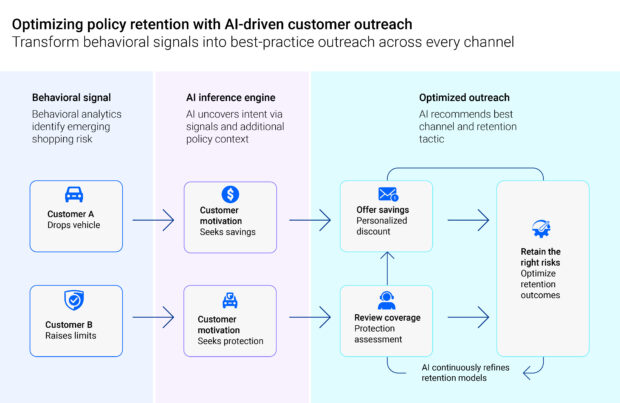
AI can continuously improve retention outcomes by learning from performance and refining strategies across channels at scale. Formalized outreach and AI usage correlate with stronger retention performance across channels. In Liberty Mutual’s 2026 Independent Agency Growth Study, retention ranked above every other priority surveyed. Respondents with improved retention were at least 10 percentage points more likely than those with flat or declining retention to report employing both formalized outreach and AI strategies.
The result is a shift from reactive to predictive retention. The future of retention may not be winning customers back at renewal; it may be preventing them from shopping in the first place.
Shifting the paradigm: Enabling adaptive AI underwriting
At a recent Verisk-hosted roundtable at Reuters’ Future of Insurance event, The Growth Engine: How AI Is Acquiring and Retaining Your Best Customers, insurance leaders agreed on one thing: the future of AI will not be defined by a single breakthrough. It will be defined by how effectively insurers connect intelligence across the customer lifecycle.
Yet many carriers remain constrained by a legacy transactional approach to underwriting data, even as they recognize that auto insurance’s multiple-rate-call model is broken. In a soft market, the pressure to control report costs often delays access to critical intelligence, reducing spend while restricting insight at the moments it can create the greatest impact.
A new paradigm is emerging.
Instead of collecting intelligence after key decisions have already been made, leading insurers are moving insight upstream. Identity resolution, household-level intelligence, predictive analytics, and workflow automation are creating a richer understanding of risk from the moment a customer begins shopping.
Platforms such as Verisk’s LightSpeed® Personal Auto are designed to help insurers meet the massive intelligence demands of continuous AI decision networks with revolutionary all-in, pay-only-when-you-bind economics.
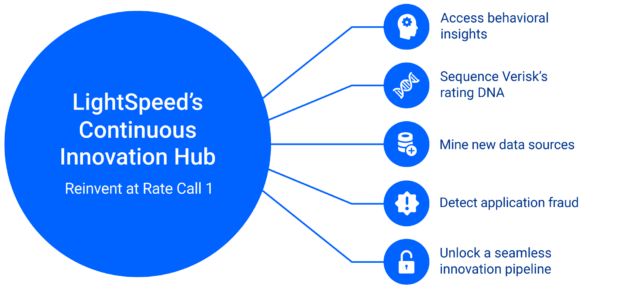
From bringing credit-based insurance scores to a place they’ve never been before—Rate Call 1—to leveraging Public Records Intelligence™ as an alternative to high-cost MVRs, Verisk is helping insurers unlock underwriting intelligence purpose-built for AI.
Get ahead of the decision
The ultimate opportunity extends far beyond faster quoting. Because the most critical underwriting decisions begin the moment a consumer enters the market, Verisk and its co-development partners are exploring a new frontier: agentic AI shopping experiences powered by continuously evolving intelligence and enabled before a traditional quote is ever generated.
Verisk views this future destination as Rate Call Zero™. The insurers that reach it first may define the next era of profitable growth.
Check out these Verisk resources to learn more:
- Retention trends: 2026 Personal Auto Insurance Retention Report
- On-demand webinar: Predicting Auto Insurance Churn with Behavioral Retention Analytics
- White paper: Auto Policy History Analytics: The Future of Risk Segmentation
- On-demand webinar: Own the Fast Lane: AI-Power Auto Innovations for Profitable Growth
See how a continuous innovation engine, transformative economics, and upfront intelligence can power the future of AI-driven insurance.
By David Ayers, Greg Firestone, and Cam Pinegar
David Ayers, Assistant Vice President Personal Auto Underwriting Solutions at Verisk, leads technology initiatives and insurance use-case development for Verisk’s LightSpeed® Personal Auto platform, providing robust data and analytics, fraud detection, and driver, vehicle, and household risk identification to accelerate quoting and drive profitable growth and smarter ROI with industry-redefining per-bind economics. David is a recognized industry advocate helping insurers challenge conventional thinking through data-forward, AI-enabled strategies that transform insurance acquisition, elevate customer experiences, and create sustainable competitive advantage. David can be reached at DAyers@verisk.com.
Greg Firestone, Vice President Analytic Solutions at Verisk, oversees personal and commercial auto, technology, data, and InflectionTM. His career before joining Verisk was at a top-10 insurer where he spent 18 years in various data science positions utilizing his deep knowledge to help improve insurance rates, refine marketing via customer lifetime value, and enhance claims processes through AI and machine learning. Greg is helping shape the future of insurance commerce through AI co-development partnerships and a vision for agentic shopping experiences that bring underwriting intelligence to Rate Call Zero™. Greg can be reached at Gregory.Firestone@verisk.com.
Cam Pinegar, Product Director, Personal Auto Underwriting, leads the development of behavioral analytics and retention solutions, including Coverage Verifier and CVAO. A recognized advocate for data-driven decision-making, Cam helps insurers harness predictive behavioral insights to improve risk segmentation, anticipate churn, and identify future loyal customers. He is currently exploring the convergence of AI and behavioral analytics to detect emerging shopping signals, enable earlier intervention, and transform retention across the policy lifecycle. Cam can be reached at Cam.Pinegar@verisk.com.
 Weather Service Confirms 2 Tornadoes Touched Down in Arizona Last Week
  Stress Is Reshaping Americans’ Lives
  AAA Survey Reveals Disconnect in Drivers’ Obeying ‘Slow Down, Move Over’ Laws
  Who Structures the Problem in AI-Assisted Insurance Decisions?