



















New research indicates cold and hot weather can significantly reduce efficiency and increase operating expenses for electric vehicles (EVs) and hybrids, according to a recently released AAA study.
Researchers tested six vehicles at cold, moderate, and hot temperatures to examine how electrified powertrains perform under non-ideal conditions and found that extreme temperatures reduce efficiency, range, and increase operating costs for EVs and hybrids.
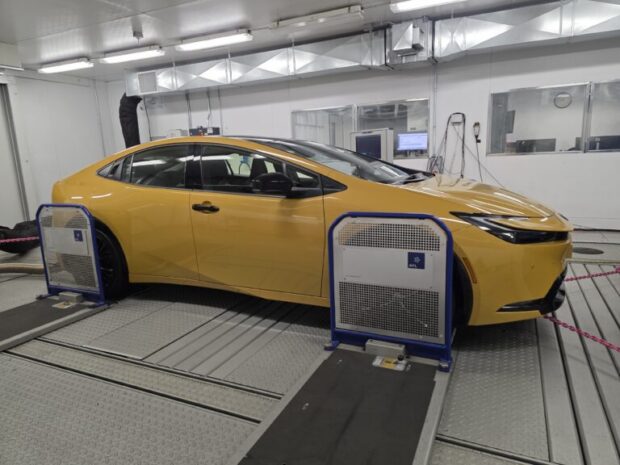
An AAA automotive engineering team, in partnership with the Automobile Club of Southern California’s Automotive Research Center, evaluated the powertrains of three EVs and three hybrids using a a chassis dynamometer — a device like a treadmill for cars — with the HVAC (Heating, Ventilation, and Air Conditioning) set at 72 degrees in the vehicles and the temperatures in the laboratory test cell at 20°F, 75°F, and 95°F.
Key Findings:
Impact of hot temperatures (95°F):
- Hybrid vehicles experience a 12.0% decrease in fuel efficiency (miles per gallon, MPG).
- EVs show a 10.4% reduction in efficiency (MPGe, miles per gallon of gasoline equivalent) and an 8.5% loss of driving range compared to moderate temperature (75°F).
Impact of cold temperatures (20°F):
- Hybrids lose 22.8% in fuel economy.
- EVs demonstrate a 35.6% drop in MPGe and a 39.0% decrease in calculated driving range.
Impacts of cold temperatures (20°F) on operating costs:
- Hybrids showed an increase in fuel cost of $28.44 per 1,000 miles.
- EVs experienced an increase in operating costs of $32.11 per 1,000 miles when charged at home electricity rates and $76.93 per 1,000 miles when using public charging.
Impacts of hot temperatures (95°F) on operating costs:
- Hybrid operating costs increased by $13.02 per 1,000 miles.
- For EVs using home charging, operating costs rose by $6.78 per 1,000 miles, while public charging costs climbed $16.25 per 1,000 miles.
Powertrain Cost Comparison:
- Cold operation (20°F) showed the largest cost gap: EVs cost $36.19 less per 1,000 miles at home electricity rates but $86.26 more using public chargers than hybrids.
- At high temperatures (95°F), EVs were $46.11 cheaper per 1,000 miles at home electricity rates but $41.00 more expensive at public charging rates compared to hybrids.
“EVs are efficient in moderate temperatures but lose significant range in the cold,” said Greg Brannon, director of automotive engineering and research at AAA. “We expected this from our previous research but were surprised by the 23% reduction in fuel economy for the hybrids in cold temperatures. Drivers should consider climate, energy costs, and driving patterns when choosing a vehicle that best fits their lifestyle.”
A separate consumer survey by AAA found that 35% of consumers are interested in hybrids versus EVs due to concerns about driving range and access to charging.
AAA recommends factoring in climate-related operating costs in the decision to purchase a vehicle.
 The Latest Launches from Soteris, CLARA, Cozmo AI
  Federal Bill Seeks to Reduce Work Week to 32 Hours
  Teen’s Death Prompts Plan to Ban New York Central Park’s Horse-drawn Carriages
  When Builder’s Risk Coverage Doesn’t Reach the Finish Line