















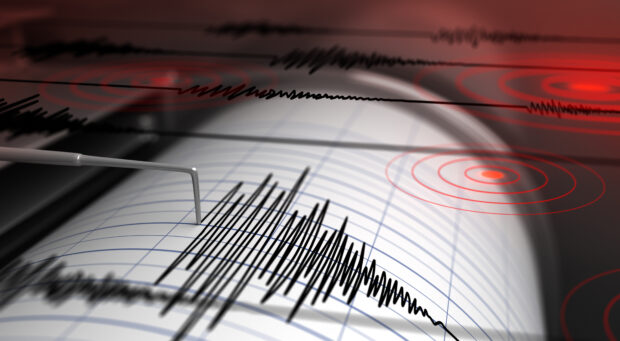
New research by the University of California – Davis suggests a much more complex, hidden fault system exists beneath the Northern California coast, indicating that tiny tremors may help forecast a major earthquake.
The area marks the meeting point of the San Andreas fault and the Cascadia subduction zone, a place capable of producing powerful and destructive earthquakes, scientists said.
The research was carried out by scientists from the U.S. Geological Survey, the University of California, Davis, and the University of Colorado Boulder, and was published Jan. 15 in Science.
First author David Shelly of the USGS Geologic Hazards Center said the challenge is similar to studying an iceberg.
“You can see a bit at the surface, but you have to figure out what the configuration underneath is,” Shelly said.
A dense network of seismometers across the Pacific Northwest was used to study the shallower tremors. The instruments recorded extremely small “low-frequency” earthquakes that occur where tectonic plates slowly slide against or over one another. These tiny events are thousands of times weaker than earthquakes felt at the surface.
The team tested their underground model by examining how these small earthquakes respond to tidal forces. Just as the gravitational pull of the Sun and Moon affects ocean tides, it also places subtle stress on tectonic plates, researchers explained. When those forces line up with the natural direction of plate movement, the number of small earthquakes increases, Thomas said.
The scientists discovered that there are five moving pieces rather than just three major plates, two of which are hidden deep below the surface.
At the southern end of the Cascadia subduction zone, the team discovered that a portion of the North American plate has broken away and is being dragged downward along with the Gorda plate as it sinks beneath North America.
South of the triple junction, the Pacific plate is pulling a mass of rock known as the Pioneer fragment beneath the North American plate as it moves northwards. The fault separating the Pioneer fragment from the North American plate lies nearly flat and cannot be seen at the surface.
The Pioneer fragment was once part of the Farallon plate, an ancient tectonic plate that once extended along the California coastline and has since mostly disappeared.
“It had been assumed that faults follow the leading edge of the subducting slab, but this example deviates from that,” Kathryn Materna said. “The plate boundary seems not to be where we thought it was.”
The findings challenge old assumptions and offer new clues about earthquake risks in one of the country’s most dangerous regions, researchers said.
“If we don’t understand the underlying tectonic processes, it’s hard to predict the seismic hazard,” said coauthor Amanda Thomas, professor of earth and planetary sciences at UC Davis.
The work was supported by a grant from the National Science Foundation. University of California – Davis. (2026, January 17). Tiny earthquakes are revealing a dangerous secret beneath California. ScienceDaily. Retrieved January 26, 2026, from www.sciencedaily.com/releases/2026/01/260117053529.htm
 Nearly 50,000 Cars Damaged by Floods This Year: CARFAX
  Why Your Boss Matters More Than Remote or Hybrid Work When It Comes to Burnout and Job Satisfaction
  Lyft to Pay $272M to Settle California Rideshare Drivers’ Wage Theft Lawsuit
  Viewpoint: The One Thing Holding Back Insurers’ AI Efforts