
















A new survey highlights drivers’ continued safety concerns regarding self-driving features in cars.
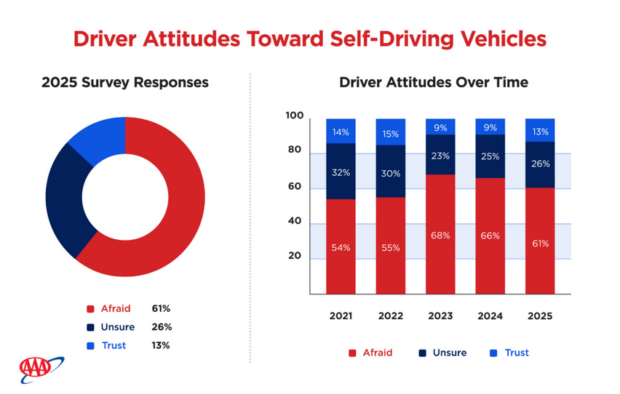
According to AAA’s latest survey on autonomous vehicles, 13 percent of U.S. drivers would trust riding in self-driving vehicles – an increase from last year’s 9 percent.
Despite the slight increase, 6 in 10 U.S. drivers still report being afraid to ride in a self-driving vehicle.
Vehicle safety systems remains a priority over the development of self-driving, with interest among drivers decreasing from 18 percent in 2022 to 13 percent this year.
Improving safety systems is important for U.S. drivers, with more than three quarters (78 percent) prioritizing safety system advancements.
The excitement surrounding new vehicle styles is a low priority, with only 24 percent of drivers viewing it as important. Enthusiasm is also low toward the development of self-driving vehicles—only 13 percent of drivers consider this a priority, a decrease from 18 percent in 2022.
While many drivers are aware of robotaxis (74 percent), 53 percent said they would not choose to ride in one.
The survey found opinions varied among different demographics.
Millennial and Generation X drivers are more likely to say they would ride in one than Baby Boomer drivers, but even among younger drivers, most say they wouldn’t ride in a robotaxi.
Collectively, interest in advanced driver assistance features (ADAS) continues to remain high.
The survey found that 64 percent of U.S. drivers would “definitely” or “probably” want Automatic Emergency Braking (AEB) on their next vehicle, 62 percent want Reverse Automatic Emergency Braking, and 59 percent Lane Keeping Assistance.
“Most drivers want automakers to focus on advanced safety technology,” said Greg Brannon, automotive engineering director at AAA. “Though opinions on fully self-driving cars vary widely, it’s evident that today’s drivers value features that enhance their safety.”
 Federal Bill Seeks to Reduce Work Week to 32 Hours
  Workers’ Compensation’s Real Challenge: Orchestration
  The Latest Launches from Soteris, CLARA, Cozmo AI
  Majority of Online Scam Campaigns Target Common Infrastructure: Study