

















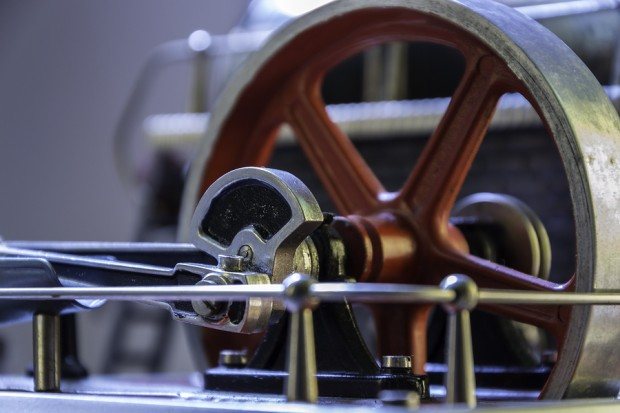
In his book, “Good to Great: Why Some Companies Make the Leap…and Others Don’t,” Jim Collins uses the flywheel metaphor to explain that great companies aren’t overnight successes.
Instead, such good-to-great transformation can take decades, and the process is somewhat like pushing a giant heavy flywheel in a single direction.
 Collins imagines a 30-foot metal disk, weighing 5,000 pounds, and describes the massive amount of effort that goes into getting it to rotate once on its axle.
After you apply enough effort to move the flywheel through that first turn, he says, consistent effort will get it to turn twice, then five or ten turns—until the momentum kicks in. The heavy weight of the wheel starts to work with the turner, and the wheel accelerates, moving faster and faster even though the same amount of effort is being applied as in the first turn.
Similarly, good-to-great transformations don’t happen in one big leap, Collins says, using examples like Wal-Mart.

Collins explains that Sam Walton began in 1945 with a single dime-store. It was seven years before he opened another and 25 years before there were nearly 40 Wal-Marts. The breakthrough momentum didn’t come until 1970-2000 when 38 stores became more than 3,000.
Explanation provided by Carrier Management
See related article, “Executive Insight: How to Elevate a P/C Carrier From ‘Good to Great'” by Michael D. Miller, president and chief operating officer of Scottsdale Insurance Company.
 How a Kelvin Wave Is Raising the Sea Level Along the West Coast
  FEMA’s New Flood Maps Mean More Homes Require Flood Insurance: Cotality
  The Latest Launches From The Zebra, Sigo Seguros, Applied Systems
  AI Data Center Boom: Understanding How Risks Are Changing