

















Our sector has a trust problem. However, this problem is a misconception about trust, not its absence or decline. Insurance professionals, from executives to front-line insurance employees, agency owners and producers, genuinely believe their clients don’t trust the sector.
Well, these concerns aren’t new. Almost 50 years ago, in The Geneva Papers on Risk and Insurance, Julius Neave wrote that “to the general public […] insurance is regarded as a kind of necessary evil”.
Even in the 17th and 14th centuries, traces of sarcasm appear about underwriters’ reputation for denying claims, raising technical objections and reducing payments.
An article from Susanne Sclafane this summer stimulated a thoughtful debate about insurance and trust, implying this has been eroded lately. We saw articulated follow-ups:
- Alan Demers conceded that the insurance sector has always had a trust problem and elaborated on the reasons for a growing trust crisis.
- A Carrier Management article represented the results of a J.D. Power survey as supporting the thesis of a lack of trust…even though it does not. Let’s look at their figures: “Asked to rate their experiences by completing the sentence, ‘My level of trust with [insurer name]'” and the answer on a curious 6-point scale: “Poor,” “Just OK,” “Good,” “Great,” “Excellent” and “Perfect,” 14% answered “Perfect” and 34% answered “Excellent” for an impressive 48% who chose the top two steps on the trust scale. However, their exotic representation of the data suggested that only 14% have high trust and 52% have low trust (since when can “good” and “great” be associated with a concept of “low”???). Even the low figures in this J.D. Power survey scream about a decent, if not even “great,” level of trust maintained by insurers.
Other surveys are providing similar evidence about a significant trust in insurers:
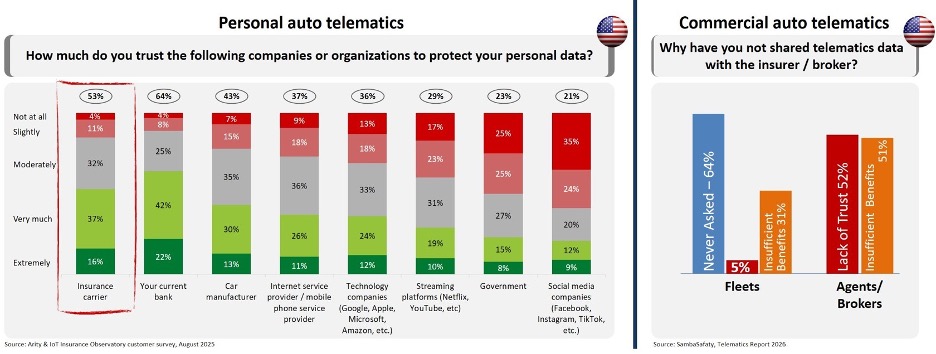
- A recent SambaSafety survey on fleets showed that among the fleets not sharing telematics data with insurers, only 5% indicated “lack of trust” as one of the reasons.
- The IoT Insurance Observatory asked personal auto policyholders a similar question in 2025: insurers ranked among the most trusted institutions for managing personal data, well above data-driven industries that now lead AI adoption.
So, why do insurance professionals assume there is a lack and decline in trust? I see five reasons (plus one) for this trust bias among insurance professionals:
Insurance reaches the media through a narrow gate, and everything through it is bad: premium spikes, denied claims, regulatory actions, catastrophe non-payment. That is how news is selected. Social media feeds are even worse—they promote grievances, and insurance grievances perform well. Insurance professionals pay significant attention to the bad insurance news and less on similar news about other sectors.
The daily job shows only the unhappy ones. We meet customers with a problem: rate increases, coverage disputes, total losses, cancellations, renewal shock. We see the regulators’ complaint files, but none weigh those complainants against the portfolio size. Satisfied customers are silent, so we receive no signal from them.
Anyone who mentions their insurance job at dinner receives a complaint, for all of their career. Nobody volunteers that their claim was handled smoothly or their premium priced fairly. It is persuasive first-hand experience, but from an unrepresentative sample in an unrepresentative mood.
The people selling us the cure are diagnosing our disease. InsurTech pitches, consultancy reports and brand agency proposals open with the trust crisis, because that crisis is what their product solves.
Everyone believes it because everyone else appears to. Colleagues, competitors, conference speakers, vendors and consultants treat it as settled, so we assume someone has grounds. Disagreeing publicly is costly. An executive who says, “I don’t think our customers distrust us” would sound complacent in a meeting addressing customer urgency. Opening a talk with the trust problem guarantees a reliable applause line, and someone else’s executive takes it as evidence. So, doubters stay quiet, unanimity looks total, and the cost of the next dissent rises.
“Nobody trusts us” is not an evidence-based conclusion. It is occupational folklore and part of an identity-protective culture of in-group solidarity and insider humor. Like the joke about ending up in insurance by accident, it is a century old.
“We all follow pretty much the same groove—we came into the business by accident, by chance,” said Mr. O. E. Lane, president of Niagara Fire Insurance, at an association banquet in 1921.
Let me be cynical: claiming a lack of trust is also the safest bet. That is the “plus one” reason. Assuming distrust makes it easier to justify a significant budget for an initiative and overcome these difficulties. Chronic distrust excuses failure, and success lets those involved claim credit for overcoming a structural barrier. For intermediaries, it can mean higher commissions for bringing that tough proposition to policyholders.
For agents and brokers, two additional reasons make it worse:
- Carrier distrust is at the foundation of agents’ value proposition; their identity depends on being the trustworthy human between customer and carrier.
- An intermediary with a satisfied book still spends a disproportionate share of the day with the dissatisfied few.
Field research shows the insurance sector is more trusted than technology companies, social media and car manufacturers. Customers already share data with firms they trust less than us. So, the barrier to connected insurance is not trust. Our position in telematics, connected insurance and everything adjacent to AI is stronger than the industry believes. If our connected programs are not flying, the reason is elsewhere: the value we offer in exchange and our own bias when we ask for the data and present the offer.
We assume we carry a heavy backpack. We are actually wearing wings.
 Insurance Loss Estimates for Microsoft Outage Range From $100M to $700M: Reports
 Trusting a Broker Facility
 Quality Engineering as the Foundation of Intelligent Insurance Systems
 New Orleans Port Sues For Tanker Control After Crash Involving Cruise Ship