













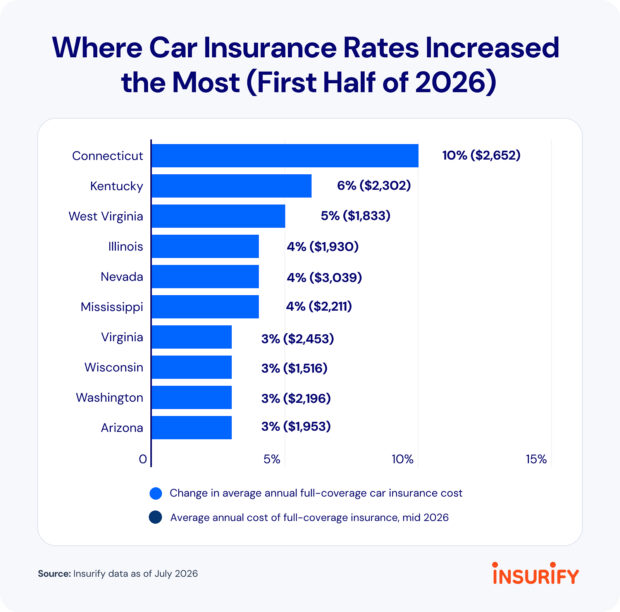
After a 6% drop in 2025, car insurance rates are projected to climb back in more than half the nation, with 27 states posting increases in the first half of 2026, according to Insurify’s 2026 Mid-Year Auto Report.
By the end of the year, 32 states are expected to see rate increases, according to Insurify’s data projections.
Connecticut drivers face the steepest year-over-year hike at 15%, followed by Kentucky (+8%), West Virginia (+8%), Nevada (+6%), and Illinois (+6%), rounding out the top five.
Kentucky drivers’ premiums went from $58 below the national average to $65 above it.
Higher repair costs are contributing to the jump in auto insurance rates, the insurance marketplace provider said.
Auto maintenance and repair costs rose 45% over the past five years.
Severe weather also contributes to higher prices in places like Kentucky, where hail events jumped from 76 a year (2020–2022) to 178 a year (2023–2025), driving up comprehensive claim costs.
While rates are rising in some historically inexpensive states for car insurance, three of the most expensive states bucked the early-year trend, highlighting rate decreases.
Full-coverage car insurance rates fell in Washington, D.C. (-7%), New Mexico (-6%), New Jersey (-5%), New York (-5%), and Massachusetts (-5%) in the first half of 2026.
Year-over-year, New York experienced a 13% rate decline since June 2025, moving it from the fifth most-expensive state for car insurance to the 10th, an annual savings average of $431.
But Empire State drivers still pay more than the national average for full coverage – $2,840 annually in New York vs. $2,237 nationally, Insurify said. Washington, D.C., and New Jersey drivers also face annual averages exceeding $2,800.
“We expect most states to see rates rise this year, and drivers should plan for that,” said Matt Brannon, Insurify senior economic analyst and a licensed agent. “After rates fell in 2025, 2026 looks to be a year of normalization. Inflation, more expensive vehicle technology, and rising claims costs are often the types of factors underlying rate increases.”
The rate increases could also shape voting, the company noted.
Nearly one-third (29%) of drivers say auto insurance costs will play a role when deciding how to vote, and 54% believe elections affect car insurance costs, according to a recent Insurify survey.
 Most Americans Think AI Is Developing Too Fast: Poll
  Majority of Online Scam Campaigns Target Common Infrastructure: Study
  Nearly 50,000 Cars Damaged by Floods This Year: CARFAX
  Federal Bill Seeks to Reduce Work Week to 32 Hours