














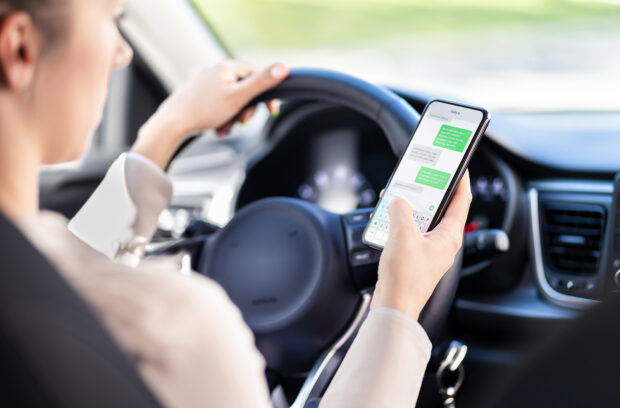
New telematics analysis indicates speeding drivers are on their cell phones more, potentially mixing two dangerous distractions, according to the Insurance Institute for Highway Safety (IIHS).
“Until now, safety experts believed drivers used their cellphones most at slower speeds,” said IIHS President David Harkey. “But data from insurance companies’ safe-driving apps show that, in free-flowing traffic, the opposite is true.”
Excluding time spent stopped at intersections, mired in traffic and driving small neighborhood streets, the amount that drivers handled their phones increased the more they exceeded the speed limit, the nationwide analysis of cellphone data showed.
On limited-access roads, the share of driving time spent handling a phone rose by 12% for every 5 mph drivers went over the local speed limit. Limited-access roads are freeways and other roads where vehicles enter and exit only via on- and off-ramps.
On other roads, such as arterials and routes that connect towns, every 5 mph over the local limit was linked to a smaller 3% increase in phone handling. These roads often have traffic lights, intersections, roundabouts and stop signs that require drivers to take action periodically, even when traffic is flowing.
An alarming relationship
The increases were larger on roads with higher posted limits. On limited-access roads with 70 mph limits, for example, for every 5 mph a vehicle exceeded the limit there was a 9% larger increase in phone handling than on similar roads with 55 mph limits.
A similar pattern was found on roads with more access than freeways.
Compared with roads posted at 25 or 30 mph, there was a 3% larger increase in phone handling for every 5 mph drivers exceeded the limit on 45 or 50 mph roads and a 7% larger increase on 55 mph roads.
“It’s alarming that the relationship between cellphone manipulation and speeding was the strongest on roads with the highest speed limits,” said Ian Reagan, the IIHS senior research scientist who wrote the study.
Several factors could be driving the pattern, said Reagan.
One is that drivers who take more risks are both more likely to speed and more likely to use their phones.
Stress is another factor.
Earlier research shows phone use spikes during rush hour and school drop-off, and those same situations may also lead people to speed. Drivers may also respond to other road cues, such as lighter traffic, an absence of pedestrians or longer gaps between stoplights, on roads with higher speed limits.
Previous studies have shown that drivers are more prone to engage in distracting activities when traveling at slower speeds or in simpler traffic settings, adjusting their behavior according to their perception of risk. But these studies did not tell the full story, IIHS researchers said.
Although some studies looked at road type and traffic, most were limited to a few settings or relied on small groups of volunteer drivers to understand how speeding fit in.
In addition, most examinations lumped together the time spent driving normally with the time spent stopped at intersections or in bumper-to-bumper traffic.
More nuanced data
More detailed information about driver behavior has recently become available with the proliferation of safe-driving apps.
Using a smartphone’s GPS and other sensors, the apps track speed and location, time of day, events like hard braking and rapid acceleration, and phone use. The large amounts of aggregated data give researchers the ability to measure phone use more comprehensively than before.
Reagan and IIHS Senior Statistician Sam Monfort analyzed nearly 600,000 trips taken between July and October 2024 by drivers across the United States, excluding Alaska, California, Hawaii and New York.
Supplied by platform provider Cambridge Mobile Telematics (CMT), the sample included people using safe-driving apps tied to passenger-vehicle insurance.
Only trips lasting at least 18 minutes, with at least two minutes on an interstate highway, were included. To limit the analysis to time spent driving in free-flowing traffic, periods spent driving more than 5 mph below the posted limit were excluded.
Drivers were counted as handling their phones when the phone’s internal gyroscope detected a significant rotation while the screen was unlocked. The phone-handling rate was calculated as total phone-handling time divided by total driving time.
To identify speeding, CMT matched each trip’s GPS location to a speed-limit database. The IIHS researchers used statistical methods to estimate phone-handling rates for limited-access roads and other thoroughfares, across different posted limits and with different levels of speeding (for example, 5-10 mph over a 60-65 mph limit on a limited-access road).
Lessons for enforcement
The independent vehicle safety watchdog said the higher likelihood of phone use among drivers speeding on high-speed roads could help direct enforcement.
This newly researched data suggests that pairing anti-speeding efforts with anti-distracted-driving efforts could have a bigger payoff, especially in higher-speed zones on limited-access roads.
Posting officers at intersections or using unmarked vans or buses to look into vehicles, can be more challenging on highways and freeways, highlighting the case for safety cameras that can monitor both speeding and phone use.
Safe-driving apps can also reduce speeding and phone handling by offering lower premiums when drivers avoid those behavior, however app users in this study illustrated that the incentives do not eliminate the problem altogether, the IIHS added.
“Speeding and distracted driving together are especially dangerous,” Harkey said. “This research shows the risk is greater than we once thought, but it also points to an opportunity to address both problems at the same time.”
 Six Flags Closes 10 Rides After Fatal Roller Coaster Accident
  Viewpoint: The ‘Unbundled’ Insurer Emerges in Age of AI as Value Chain Fragments
  Why Your Boss Matters More Than Remote or Hybrid Work When It Comes to Burnout and Job Satisfaction
  San Diego PD Considers Using AI to Write Police Reports