













Drivers struck and killed 7,148 people in the United States last year, enough to fill 31 Boeing 737s, according to a new report from the Governors Highway Safety Association (GHSA).
Pedestrian deaths declined to 4.3 percent in 2024, the second consecutive year posting a reduction.
Pedestrian fatalities remain nearly 20 percent above the 2016 level and reached a 40-year high in 2022.
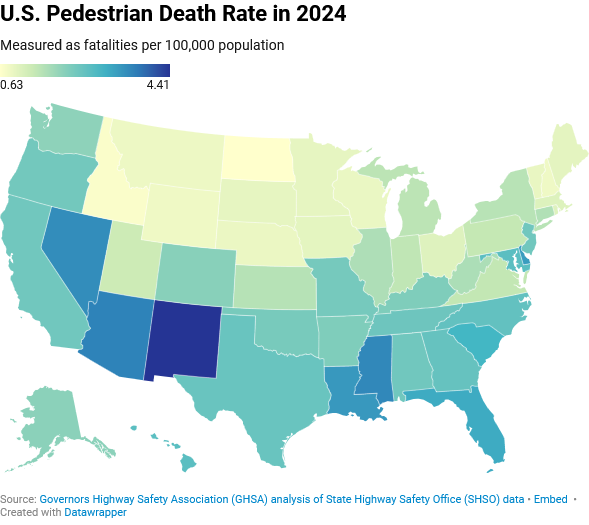
New Mexico tops the list for most pedestrian deaths, with Arizona, Nevada, Mississippi, and Louisiana rounding out the top five states.
GHSA’s new data analysis, Pedestrian Traffic Fatalities by State: 2024 Preliminary Data, provides a first look at pedestrian safety trends and changes in fatalities at the state level.
The new report analyzes 2023 data from the National Highway Traffic Safety Administration (NHTSA) that reaffirms trends related to pedestrian deaths in hit-and-run accidents, at night, in places with no sidewalks, and in crashes involving SUVs and pickups.
State Highway Safety Offices (SHSOs) and their partners are leveraging enforcement, data, technology, education, infrastructure, and other solutions to improve pedestrian safety.
“The second straight year of fewer pedestrian deaths is a step in the right direction, but much more must be done to protect people walking,” said GHSA Chief Executive Officer Jonathan Adkins. “Now is the time to double down on what works – more and better infrastructure, enforcement to deter dangerous driving behaviors, engaged and informed communities, and vehicles designed to protect people on foot. An all-in strategy to address pedestrian safety will help us build on this recent momentum and save even more lives.”
The report found that one in four pedestrian deaths is the result of a hit-and-run crash.
Over the past five years, 25 percent of fatalities have involved a crash where a driver involved in the crash flees the scene. In these fatal hit-and-runs, the vehicle that struck the pedestrian was the fleeing vehicle the vast majority (94 percent) of the time.
Pedestrian deaths are increasing at a rate much faster than overall traffic fatalities.
Between 2009 and 2023, pedestrian deaths rose 80 percent, while all other traffic fatalities increased 13 percent.
There were 225 fewer pedestrian deaths in 2023 compared to the prior year, but there were 1,478 fewer fatalities from all other traffic crashes.
The share of pedestrian deaths caused by SUVs and pickups has surged.
While the number of pedestrian deaths involving passenger cars and light trucks (including SUVs, pickups, and vans) was largely similar for much of the 2010s, a significant gap emerged and has grown since 2019.
Light trucks accounted for 54 percent of pedestrian fatalities where a vehicle type was known in 2023, compared to 37 percent for passenger cars.
More than three-quarters of pedestrian fatalities occur after dark.
Fatal pedestrian crashes at night nearly doubled from 3,030 in 2010 to 5,578 in 2023, an 84 percent increase, compared to a 28 percent rise in daylight fatalities (from 1,092 in 2010 to 1,396 in 2023).
Nearly two-thirds of pedestrian deaths occurred in locations without a sidewalk in 2023.
Since 2017, the number of pedestrian fatalities in places without a sidewalk rose by 1,164, compared to an increase of 167 in locations with a sidewalk, the report found.
In 2023, nearly 1,200 people died on freeways and interstates.
Stranded motorists exiting their vehicles, first responders, and tow truck drivers are all examples of people killed on freeways. All states have Move Over laws designed to address this problem, but they are difficult to enforce.
Digital alerting technology that warns drivers of vehicles on the roadside can help reduce these types of crashes, the GHSA report stated.
Alcohol impairment by both drivers and pedestrians remains a significant safety concern.
In 2023, 29 percent of pedestrians 16 and older killed in motor vehicle crashes had a blood alcohol concentration (BAC) of 0.08 or higher.
An estimated 16 percent of fatal pedestrian crashes involved a driver with a BAC over 0.08.
 The Latest Launches From The Zebra, Sigo Seguros, Applied Systems
  Amazon Cargo Plane Pilots Weren’t Warned About Wind Before Miami Crash: NTSB
  Sedgwick: Property Claims Face Delays, Are Growing More Complex
  Weather Damage Turning Into Long-term Debt for Homeowners: Report