


















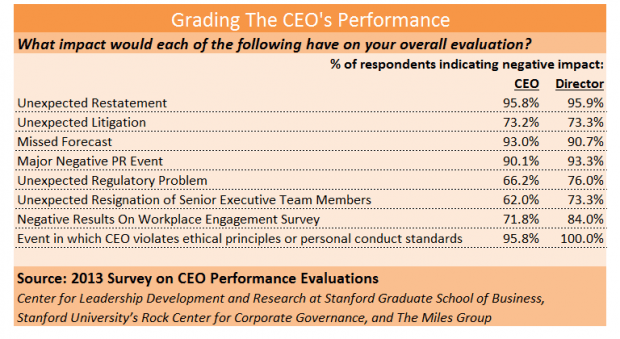
Seventy-three percent of board members of public and private companies across various industries said that the unexpected resignation of senior executive team members would have a negative impact on the board’s evaluation of a company’s CEO.
The board members—and the CEOs themselves—were asked to what impact that such a departure, as well as other unexpected events, would have on the performance evaluations of the CEOs as part of a study conducted by the Center for Leadership Development and Research at Stanford Graduate School of Business, Stanford University’s Rock Center for Corporate Governance, and The Miles Group.
The Directors said they would also be concerned about negative results on a workplace engagement survey, with 84 percent saying that this would have a “very negative” or “moderately negative” impact on the CEO evaluation.
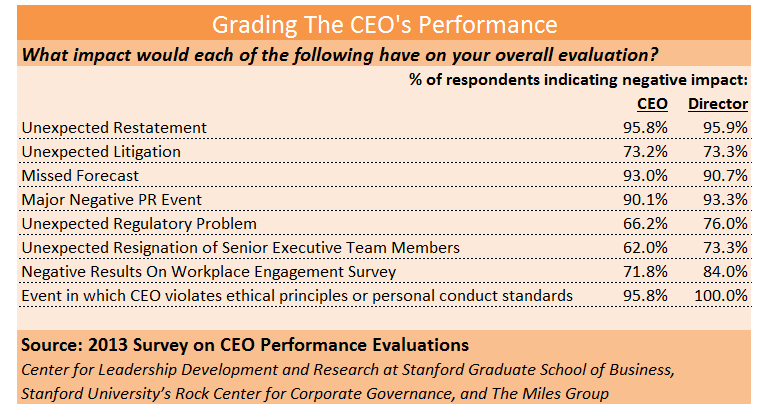
In response to the question about senior management team departures, 62 percent of the CEOs indicated that this would impact their performance evaluation negatively, and roughly 72 percent thought the negative workplace engagement survey would impact their own performance evaluations.
In terms of external events, directors are also concerned about unexpected regulatory problems.
Neither boards nor CEOs are willing to overlook breaches of ethics.
More details of the 2013 Survey on CEO Performance Evaluations are described in a related article, “Boards Unhappy With CEO Mentoring, Board Engagement Skills.”
 Highway Safety Agency Plans to Revise Outdated Vehicle Lighting Rules
  The Latest Launches from Vertafore, One Inc., Qumis
  Laws to Protect Workers from AI Risks Signed by California Governor
  Why Your Boss Matters More Than Remote or Hybrid Work When It Comes to Burnout and Job Satisfaction