












Sometimes, it takes a few tries to develop the right insurance or reinsurance product—one that will align well with the needs and wants of customers.
Kettle, a company that uses technology to better understand catastrophic risks, and uses that understanding to sell insurance and reinsurance as an MGA, has already developed three offerings that garnered support of capacity providers.
Related article: Grid-by-Grid: How One Tech Firm Dissects California Wildfire Risk to Sell Insurance and Reinsurance,”
But before leveraging machine learning models that accurately assess ignition risks and patterns of wildfire spread in California to deliver a reinsurance offering known as Grid Rated Industry Loss, or GRIL, a commercial E&S wildfire product and an excess insurance for high-value homes, the company missed the mark with two earlier coverage schemes, according to Co-Founder and Chief Operating Officer Nathaniel Manning.
Kettle’s first technology-based insurance product idea was a wildfire evacuation insurance policy. “If you are in a mandatory evacuation zone, we’ll put 3,000 bucks in your bank account in under an hour and it’ll cost roughly $20 a month,” Manning said, describing the substance of the product that seemed like a super-efficient way to help homeowners in harm’s way.
Kettle built a version of the product and applied to Y Combinator. The startup accelerator questioned Kettle’s distribution model, premised on the idea of advertising to convince people to buy evacuation insurance.
It turns out that Y Combinator was right in believing that people wouldn’t welcome the idea of buying additional insurance, Manning admitted. Market research confirmed it. Potential customers said they wouldn’t even pay the price of two or three coffees a month for that protection when Kettle asked random folks shopping around in Berkeley Hills. They dismissed the idea even as fires were burning elsewhere in California—in Sonoma County.
Kettle entrepreneurs reassessed their business model. “We actually don’t want to be a marketing company. We’re really technologists. We want to focus on using what we’ve already built here, which is a smart AI model to understand this risk. Let’s build on that,” they decided, realizing that another key building block was their knowledge of reinsurance. Before joining Kettle, Co-Founder Andrew Engler headed up the digital product and machine learning team of Argo Group, which has a reinsurance business in Bermuda. Chairman Nigel Mortimer, a seasoned insurance executive having spent 30 years in the industry primarily in London and Bermuda, was a past president and EVP for Argo.
Moving forward with a reinsurance MGA model next, Kettle incorporated the company on Feb. 28, 2020. “Ten days later we were all in lockdowns,” Manning recalled, as he recounted the early struggles of the company during a recent interview.
Engler recognized that this actually would work in the startup’s favor.
“Reinsurance companies thrive when everything else is contracting,” Manning said. He recalled Engler’s sense that uncertainty about ultimate levels of COVID losses would cause some market participants to stop deploying capacity, which would, in turn, cause pricing to skyrocket. The timing gave Kettle “the opportunity to actually come in and capture more business with a new AI-driven view of risk,” Manning said.
Financing the buildout themselves through the summer, the startup secured a seed round in July and went to market with its first reinsurance product—a cat strip. “It totally failed,” Manning said, describing an offering that was meant to help primary carriers lower reinsurance costs that spiked in the aftermath of 2017 and 2018 wildfire losses by essentially stripping some fire exposures out of all perils/all states reinsurance contracts.
Kettle set out to sell a fire-only reinsurance contract. “We’ll strip out all the risk that everybody else thinks is really expensive and dangerous but we’re willing to write,” he said, recalling the rationale that also assumed the reinsurers would drop their prices for the rest of portfolio.
“The truth is no one likes that because they think that we’re cherry-picking the best risks and they’re getting left with the bad stuff,” Manning said. This wasn’t quite true. Kettle was actually interested in “mispriced risk”—risks that were “mispriced up and down the low-to-high risk pipeline,” he said.
Why Wildfire?
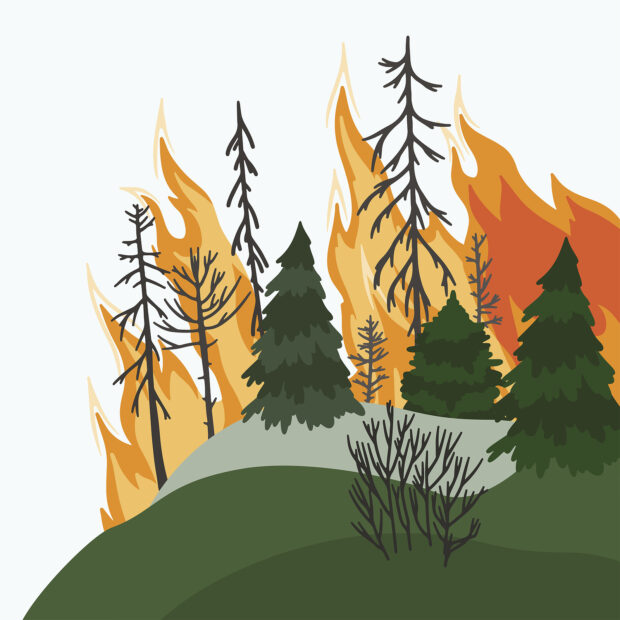
Kettle’s AI models—and the insurance and reinsurance products that did get off the ground—have all focused on California wildfire initially. Manning offered two conditions in the wildfire underwriting space as reasons for this starting point in building the technology and MGA business: bigger datasets to train models and more price dislocation.
Imagining a classic 2×2 grid, with the X-axis measuring the ability for machine learning to do a better job than statistical modeling, fire is all the way on the far right “because there are actually 10,000 wildfires a year in California, and 10 of them cause 99 percent of the damage. That’s a great dataset to train a model off of. And all the major factors are things that you can get from satellite imagery and weather data, like wind and digital moisture index and topography.”
On the other end of the spectrum would be earthquake. “Earthquake is really stochastic. It’s really hard to predict. [So,] everyone uses the same statistical modeling on the USGS (U.S. Geological Survey) information.
Going on to describe the Y-axis of his 2×2 decision matrix, measuring price dislocation, Manning said, “We could come up with a model that we think is more accurate for flood risk, but if it costs 50 percent more than everybody else’s, no one’s going to care that it’s right. They’re just going to buy the cheapest product in the market.” In other words, “you have to wait for the existing market to become more expensive than what our model says the actual risk is.”
“What we noticed in fire was after the 2017 and 2018 losses in California, the pricing had really [been] driven up,” he said, noting that this was compounded in 2020 by uncertainty about COVID losses, which caused a spike in all-peril standard reinsurance policy prices.
Why Climate?
Manning’s own journey to co-founding a tech company in the insurance and reinsurance space started with graduate studies of international environmental sciences and sustainable design, followed by work in the clean technology sector and then roles that involved opening up data to guide disaster response. A common thread weaving together all the entries on his pre-Kettle resume: a motivation to do something about climate change or its impacts.
Asked why his career moved in that direction, Manning said, “I’ve always been really drawn to big problems, things that feel like they are really going to affect a billion people or more.” He wondered, “How do you get everyone to work together to try to solve for this?”
Reflecting some more, he recalled that seeing the film “An Inconvenient Truth”—a documentary about former U.S. Vice President Al Gore’s campaign to educate people about global warming—left an indelible impression when Manning saw it in the early days of his college career. “It really just blew my mind. I thought, ‘Wow, this is happening, and it affects every part of our economy and everything we do. This is going to be a major thing.'” I readjusted my class load and major,” he said, explaining that he pursued a master’s in environmental science and international relations in the hopes of having some part in trying to build consensus around stopping the progression of global warming.
Another possible factor. “I grew up on a farm in Pennsylvania. I think I always had a bit of an appreciation for the relationship between humans and the Earth,” Manning said.
Read more about Manning, the backstory of Kettle, and the AI-based technology behind its insurance and reinsurance offerings in the CM magazine article, “Grid-by-Grid: How One Tech Firm Dissects California Wildfire Risk to Sell Insurance and Reinsurance.”
Read more articles about developments in the California and Florida insurance and reinsurance markets in the online publication of CM’s third-quarter magazine, “California Insurance Market in Crisis” or by downloading a full PDF of the third-quarter edition.
 Policy Disconnects, Deferred Mitigation Escalate Weather-Related Claims
 INSTANDA CEO Sees Governance, Human Oversight As Top AI Priorities
 Road Deaths Declined to Historic Levels in First Half of 2026
 How AI Tracks Digital Footprints to Uncover Fraud