















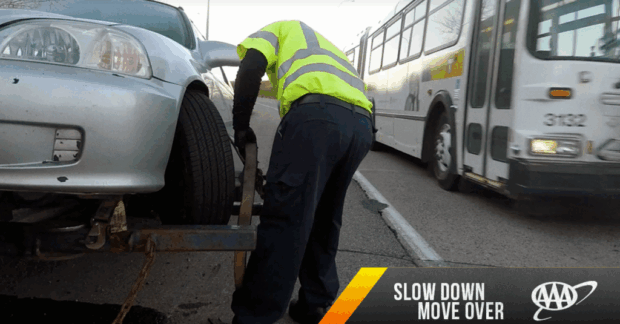
Despite “Slow Down, Move Over” (SDMO) laws designed to prevent emergency responder injuries and deaths, a new study from the AAA Foundation for Traffic Safety (AAAFTS) finds that confusion about the laws and inconsistent enforcement are putting responders at continued risk.
“For more than 20 years, AAA has championed ‘Slow Down, Move Over’ laws in every state, yet we are still losing far too many roadside heroes in the line of duty,” said Gene Boehm, president and CEO of AAA National. “It’s clear that awareness alone isn’t enough. Drivers need to understand what these laws require and why they matter.”
While every state and the District of Columbia has a “Slow Down, Move Over” law, many drivers don’t fully understand what those laws require, AAA found.
In a forthcoming AAAFTS national survey, two-thirds of drivers have heard of SDMO laws, but many couldn’t say whether their state has one or what the law entails.
Drivers are far less likely to move over or slow down for tow trucks or stranded vehicles than for police, revealing a widespread misconception about who the laws are designed to protect.
“Slow Down, Move Over laws exist to protect roadside heroes, first responders, and the stranded motorists whom they serve. However, as these statistics demonstrate, drivers do not always follow the law, all too often resulting in preventable tragedies,” said Dr. David Yang, president and Executive Director of the AAA Foundation for Traffic Safety.
When researchers reviewed real-world footage of drivers passing roadside incidents, they found only 64 percent of vehicles either slowed down or moved over. The remaining 36 percent did neither.
Changing lanes was far more common than reducing speed, suggesting that many drivers are missing half the law’s intent.
Tow truck operators face the greatest risk, the research found.
Only 58 percent of drivers witnessed in surveillance footage slowed down or moved over when a tow truck was stopped on the roadside, compared to 66 percent who slowed down or moved over for police vehicles.
Intentions don’t match actions.
Most drivers reported that they complied with SDMO laws, but roadside video revealed otherwise—especially when it came to reducing speed.
Drivers perceived little risk of being ticketed, and penalties vary widely—from $30 in Florida to $2,500 in Virginia.
“Every responder working on the roadside deserves to make it home safely,” said AAA Director of Traffic Safety Advocacy and Research Jake Nelson. “We need clear, consistent laws, visible enforcement, and education that resonates with drivers. When everyone understands what ‘slow down, move over’ really means, we can make our roads safer for those who protect us every day.”
AAA is encouraging policymakers, enforcement agencies, and safety partners to strengthen and align their approaches to “Slow Down, Move Over” laws—making them clearer, more consistent, and easier for drivers to follow.
 Viewpoint: The One Thing Holding Back Insurers’ AI Efforts
  Federal Bill Seeks to Reduce Work Week to 32 Hours
  Most Americans Think AI Is Developing Too Fast: Poll
  Viewpoint: Insurers Are Automating the Front Office While Ignoring the Function That Determines Trust