


















Modern property/casualty claims intake is increasingly driven by multimodal interactions. Even simple auto claims now arrive as a bunch of ACORD notices, claimant narratives, damage photos, scanned repair estimates, emails, and call records. Property claims add complexity through aerial imagery, contractor reports, and handwritten notes; catastrophic events additionally tighten intake time frames.
Claims leaders are under extreme pressure to make claim processing faster, reduce manual rekeying, and control leakage and fraud as traditional claims automation hits a ceiling at that point. Linear extraction logic cannot effectively adapt to dynamic intake processes and handle unstructured evidence streams. Specialized artificial intelligence tools are better at processing unstructured submissions, but designing AI automation to handle multimodal claims without turning every handoff and exception into manual work is still difficult.
Agentic AI is what the industry conversation today frames as the answer to automated multimodal intake, and fairly so. Agentic AI refers to AI systems built around software agents that can plan and execute multi-step tasks, “talk” to other software and AI models, use enterprise data, and trigger actions in connected systems under defined rules. In claims intake, this means an agentic AI setup can coordinate intake across emails, forms, photos, policy data, and so on; decide which AI model or rule should process each input; request missing data from claimants; validate outputs; and route exceptions to human reviewers.
This broader role is what makes agentic AI attractive for multimodal intake. But it is also what makes the architecture difficult to get right. Once agents start coordinating multiple claim inputs and procedures, weak design choices quickly affect the accuracy, cost, auditability, and scalability of such solutions.
Four common architecture traps can arise in the early stages of claims AI initiatives:
- Relying on a single model for all modalities, which degrades accuracy.
- Defaulting to the most powerful model for every intake task, which raises the cost per claim.
- Letting a single AI agent run the entire workflow, which limits parallel processing and makes failures harder to isolate.
- And using AI outputs without deterministic validation rules, which lets errors slip through.
Let’s break down these traps and explore a realistic AI architecture that overcomes them. For insurance leaders, understanding these misconceptions is critical to building AI systems that are scalable, governable, and economically viable in production.
Architecture Trap #1: Treating Multimodal Intake as a One-Model Problem
The idea of one universal model looks elegant on the whiteboard. But reality hits us with diverse claim data formats and intake modalities that scale differently, fail in different ways, and pose distinct computational problems. Solving all of them with a single model would force insurers into trade-offs they do not actually want: high inference costs, low explainability, and unstable outputs at scale.
Accuracy degradation across long intake chains is the biggest limitation. A single enterprise large language model (LLM) boosted through prompt engineering and retrieval-augmented generation (RAG) can handle individual claim tasks (document intake, policy clause retrieval, evidence analysis, etc.), but once that LLM is used to handle the entire claim intake process, total accuracy drops. The reason is cumulative error propagation: small inaccuracies introduced at one stage distort subsequent steps, and a single model lacks the awareness and independent validation mechanisms needed to detect and resolve these gaps.
If one model cannot realistically handle multimodal intake, what stack of AI models are we looking at then?
Conversational intake (e.g., via free-form emails or calls) requires models with strong reasoning and contextual interpretation capabilities. Claimants describe accidents emotionally, omit details, confuse timelines, and shift terminology depending on stress levels and communication style. LLMs are extremely valuable for interpreting intent, structuring narratives, identifying missing information, and maintaining conversational continuity.
For damage photo analysis, you need models that can classify objects, interpret contextual scenes, and verify image authenticity. Traditional computer vision models trained on highly specialized datasets continue to perform well for these tasks. Plus, large vision-language models (LVLMs), a relatively new class of models capable of vision-language reasoning, are an option when you need multi-image interpretation, visual-document matching, or conversational assistance for inspectors. LVLMs can assess whether damage shown across multiple photos and videos is consistent with the reported loss, explain gaps between images and inspection notes, and answer an inspector’s questions about the evidence by reasoning over both images and claim documents.
Structured documents like ACORD forms, repair estimates, invoices, and inspection reports typically follow relatively stable structural patterns. Here, the most effective approach often combines traditional optical character recognition (OCR) with encoder models fine-tuned for named entity recognition (NER) and semantic classification. Such models identify, extract, and classify information already present in the documents so it can be further validated and used for claims decision-making. Unlike LLMs, they do not generate new content, meaning there’s no risk of hallucinations or unsupported outputs.
The architectural task is thus building an agentic system that can process each claim modality using the most appropriate models.
Architecture Trap #2: Defaulting to the Most Powerful Model for Every Intake Task
Some intake tasks can be performed by more than one type of AI model. A common assumption is that once a more powerful model becomes available, it should replace the existing one, since it will be more productive or efficient. However, this approach can quickly inflate intake costs.
Visual evidence processing is a good example. Both traditional computer vision and LVLMs can handle this task. As LVLMs continue to advance, many organizations consider routing every evidence photo through them and eventually retiring their computer vision setups. While this simplifies the architecture, it also means paying for advanced reasoning on every claim, even when the damage is straightforward and can be assessed reliably by a much less expensive computer vision model. This is like calling an astrophysicist every time you need help with a middle-school physics problem.
For property/casualty insurers, the strongest long-term economics often come from using several models for different situations within the same workflow. This approach requires model routing logic — a decision engine that evaluates the complexity of each case, decides which model should process each set of submitted photos, and routes the images accordingly.
Taking the visual evidence example above, the routing logic would first send simple damage photos like a clearly visible windshield crack or a minor bumper dent for processing by a computer vision model. Only if the computer vision model produces a low-confidence result, or if the evidence contains ambiguous damage or possible fraud indicators, would the system escalate processing to a more expensive LVLM.
The same principle applies across conversational intake, document extraction, and external verification workflows. Regardless of the modality, the objective is not to have the most powerful model for the task, but to use the most cost-effective one in the given context.
Today, major cloud AI platforms already support this approach natively. Microsoft Azure AI Foundry and AWS Bedrock both provide frameworks for coordinating AI model execution dynamically.
Architecture Trap #3: Letting One AI Agent Run the Entire Workflow
Once you stop treating multimodal intake as a one-model problem, the next design question is how these models should be used inside the claim workflow. A model can perform a specific intelligence task, such as interpreting a claimant’s narrative or classifying damage in a photo. But it does not own the surrounding workflow: preparing inputs, calling the right tools, checking business rules, using claim data, or passing the result to the next step. This is where AI agents come in. An agent uses models, rules, enterprise data, and connected tools to complete a broader workflow task.
For many insurers considering agentic AI for claims, one powerful agent that handles the entire intake process may seem like a natural fit. It could review claim documents, analyze damage photos, communicate with claimants, decide which systems to call, validate results, and coordinate the workflow from start to finish. There’s only one agent to build, one place to configure business logic, and one engine responsible for every decision.
In practice, however, this setup concentrates too much responsibility in one place. A single agent now needs broad access to all claim data, business rules, and enterprise systems, making it harder to control security and isolate failures. Plus, this agent uses the same reasoning engine for every task, even though different tasks have very different processing requirements, which often slows execution and escalates processing costs. Finally, because all capabilities are baked into a single component, improving or replacing one workflow would often require reengineering the entire agent.
That’s why a better approach is to design multimodal claims intake around specialized agents with narrow responsibilities and clearly defined access boundaries. One agent processes FNOLs, another focuses on visual evidence, the third handles external verification, and so on. Each agent uses the AI models best suited to its task and can access only task-relevant data and tools.
This split creates several operational advantages.
First, each agent maintains a narrower and cleaner contextual scope. The photo intelligence agent doesn’t need to maintain conversational memory. The document extraction agent doesn’t need image segmentation capabilities. This improves reasoning consistency and reduces inference costs.
Second, agents can operate in parallel. While one agent processes damage imagery, the other parses conversations, and the other extracts structured data from invoices. This accelerates claim intake and makes it easier to compare evidence across modalities for fraud indicators.
Third, data security becomes easier to manage. Giving each agent access only to the data and tools required for its task reduces unnecessary exposure of claimant data. It also makes it easier to audit how agents access and use data, enforce least-privilege access, and control AI compliance with internal security policies and regulatory requirements.
Finally, task-specific agents are easier to benchmark, evolve, and govern independently. If you improve your conversational models, you don’t need to redesign the entire intake ecosystem. If better vision algorithms emerge, you can only replace the photo intelligence agent. If intake metrics worsen, you can quickly spot the drifting agent and make targeted refinements.
But specialized agents still need coordination. This is where an orchestrator comes in. Think of it as a traffic controller for the intake flow: it assigns tasks to the right agents, manages handoffs, triggers validation, and sends exceptions to human review. Unlike task-specific agents, the orchestrator does not analyze claim evidence, extract data, or generate intake outputs itself — its only job is to control how work moves between agents and systems. A sound architectural choice is to place the orchestrator outside the agentic processing layer, so routing, validation, escalation, and workflow state management remain centrally governed rather than hidden inside individual agents.
Architecture Trap #4: Trusting AI Output Without Deterministic Validation
Let’s say we’ve decided which models and agents to use to process claim evidence. At this stage, the last architecture problem is whether we can trust the processed result. Unfortunately, AI models are probabilistic by design: they infer the most likely answer rather than guarantee exact, repeatable results. This makes them useful for interpreting messy claim evidence, but it also means extraction errors, overgeneralized summaries, and output variance are normal risks we need to account for.
Conversational intake is particularly vulnerable. Large language models may unintentionally distort timelines or omit important details, especially when claimants speak emotionally. Even highly accurate models can gradually introduce interpretation drift over the course of the intake process.
The most realistic way to address the risk of error is to enforce deterministic validation of AI intake outputs. In practice, this means running AI output through predefined hard rules — no more AI inference. A deterministic rule can verify that the policy ID exists, that the policy was active on the loss date, that required fields are filled, that dates use the correct format, that invoice totals add up, and so on.
One common approach is to implement a dedicated validator service for that. The service matches extracted data to required data structure and business rules, reconciles it with trusted systems of record, and identifies gaps and duplicate data. The validator then returns a clear validation result. If all mandatory checks pass, the output can move to the next claim processing stage. If a rule allows automatic correction — for example, normalizing a date format or choosing the newest duplicate record — the service applies it and logs the change. If a mandatory check fails, there’s conflicting evidence, or a preset fraud trigger appears, the output is blocked from straight-through processing and sent for missing data collection, additional automated checks, or human review.
The validator’s rule-based logic keeps this control layer predictable. It can also be updated as policy rules, claim handling practices, forms, and regulatory requirements change.
Human review pipelines are also must-haves in such a setup. The validator needs a structured path to escalate conflicting and low-confidence intake outputs for a human check. Designing human escalation logic and defining the conditions under which automation should stop before developing agent logic can help insurers narrow the agent’s scope from the start. This helps avoid agent overengineering without weakening AI controls.
What a Realistic Agentic Intake Architecture Looks Like
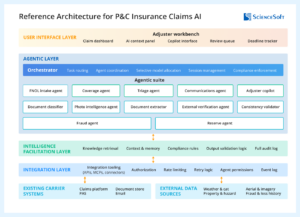
To work well, an AI architecture for multimodal claim intake should combine multiple specialized agents, each optimized for a specific intake task and powered by the AI models best suited to that task. You also need an orchestrator to coordinate the agents, dynamically select the most appropriate models, and route claims through deterministic validation and human review whenever additional control is needed.
For reference, let’s look at the end-to-end claims AI architecture originally developed by ScienceSoft for personal property/casualty claims. This architectural pattern can also be adapted to commercial property/casualty, life, and health insurance.
The proposed architecture relies on task-specific agents, with six of them involved in intake automation. The orchestrator routes tasks, coordinates agents, selectively allocates models, and monitors intake compliance with the insurer’s internal policies and regulatory deadlines.
Claims specialists track intake operations and verify the accuracy of AI outputs through a dedicated adjuster workbench. With the human workspace separated from the AI execution layer, you can refine adjuster workflows without changing the underlying agentic architecture.
The intelligence facilitation layer hosts the logic and services required for accurate and compliant AI work, including proprietary claim routing, compliance, and validation rules, data retrieval and memory components, and mechanisms for audit logging. Keeping these capabilities in a separate, shared layer allows reusing them across multiple agents while maintaining consistent governance and compliance.
Beyond avoiding misconceptions and covering all critical components, there are two design decisions that make this architecture truly production-grade:
Layered integration architecture: In the proposed design, the agent suite and the orchestrator are deployed as a separate layer rather than embedded into core claims systems. This allows insurers to add, replace, and expand AI-driven intake workflows without redesigning existing claims platforms or intake infrastructure. The unified integration layer makes it easier to connect fragmented systems and control data exchange across channels. You can also add new APIs, protocols, and external connectors without affecting agent logic as the system evolves. This design simplifies integration with legacy systems, removing one of the biggest barriers to implementing enterprise agentic AI.
Modular agent design: Modularity allows insurers to gradually grow their agent stack without redesigning the entire platform. For example, you can initially roll out an intake agent for only one modality (FNOL, document, or photo intake) and add new task-specific agents as employee confidence and governance maturity increase. This approach lets you start your claims transformation journey with minimal investment, minimal changes to your existing claim intake model, and minimal technology risk. It also works well for phased modernization programs, where you expand an existing claims platform with agentic intake features. Plus, you can freely combine commercial agent tools and custom claims agents in one framework.
 Insurance Loss Estimates for Microsoft Outage Range From $100M to $700M: Reports
 Multimodal Claims Intake with Agentic AI: A Practical Architecture
 Oversight, Safety Questions Raised in Deadly Brooklyn Building Collapse
 Nvidia’s Insurance Protects Board, but Securities Litigation Threatens Company Coffers