


















EvenUp Law, the leading AI provider to the plaintiff bar, tells its prospective customers that its technology produces a 30% increase in settlement values, a 70% increase in policy limit demands, and a 30% improvement in adjusters tendering limits. One happy customer on their website says that EvenUp gave their firm a 300% lift in settlement values.
Executive Summary
The plaintiff bar’s investment in AI-driven negotiation tools isn’t just changing case outcomes. It’s reshaping the financial structure of property/casualty insurance.John Burge of SigmaSight.AI and Taylor Smith of Suite 200 Solutions take a look at the numbers to make a financial case for carriers to focus on better negotiation discipline, earlier positioning, written evidence-based advocacy, and defense-side AI.
They have raised nearly $400 million in capital, achieved a valuation exceeding $2 billion, and claim thousands of law firm users. And they are only one of a growing number of plaintiff-side AI tools.
Let’s assume, for the sake of argument, that those numbers are directionally correct, but sales hyperbole. Our intelligence is that it is half that, but let’s say it is a third—10%. What does a 10% increase in settlement values mean for P/C carrier economics?
This article presents a straightforward financial model to answer that question. It is intended for claims leaders, litigation executives, and the CFOs and CEOs who depend on them. The math is not complicated. But the implications are significant.
What Carriers Actually Spend on Liability Indemnity
To understand the financial exposure, we first need to understand where indemnity sits inside a carrier’s cost structure.
For a representative $10 billion diversified P/C carrier writing a 60/40 commercial-to-personal split, assume approximately 47% of total premium corresponds to liability bodily injury exposure. Translated, that’s roughly $4.5 to $5.0 billion in liability premium. We’ll use $4.75 billion as our midpoint.
On BI-heavy lines — commercial and personal auto liability, general liability, professional liability— the pure loss ratio (indemnity payments as a percentage of premium) runs approximately 72 percent. That is the single largest cost any carrier bears. It dwarfs legal expense, claims operations, and underwriting overhead combined.
For context, here is how a typical dollar of liability premium breaks down:
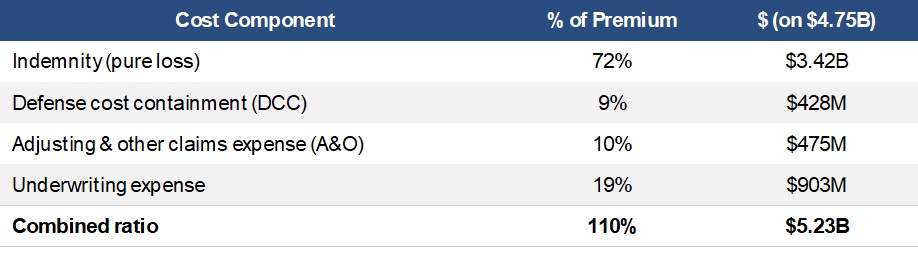 The combined ratio of 110 percent is not a hypothetical. For many BI-heavy commercial and personal auto liability lines, this has been the reality over the past decade. These lines have been structurally unprofitable, subsidized by investment income and more profitable property books.
What a 10 Percent Increase in Settlement Values Actually Costs
Now apply the plaintiff bar’s own claim. If AI-enhanced negotiation tools increase settlement values by 10 percent, (just one third of what EvenUp claims), that increase applies to the indemnity line — the 72 percent figure above.
The breakdown in the chart above is a composite estimate based on 2024 statutory data (S&P Global Market Intelligence, AM Best, NAIC) for BI-heavy liability lines including commercial auto liability, other liability, and CMP liability.
Individual carrier results vary with line mix and operating model.
The underwriting expense % estimate reflects an efficient large carrier. Smaller or less efficient commercial writers would see 25–32%.
A&O is non-defense allocated loss adjustment expense plus unallocated (ALAE + ULAE)
On our $4.75 billion liability base, the indemnity spend is approximately $3.42 billion. A 10 percent increase would add roughly $342 million in annual indemnity cost to a single carrier. That is not an industry-wide number. That is one carrier.
To put it in ratio terms: a 10 percent increase in indemnity would move the pure loss ratio from 72 to approximately 79 percent and push the combined ratio from 110 to roughly 117 percent. No carrier survives that for long.
These are not edge cases. These are the mathematics of what happens when one side of the negotiating table systematically improves its ability to extract value and the other side does not respond.
The Flip Side: What the Defense Can Recover
The same math works in reverse. If defense-side AI tools and improved negotiation discipline reduce variability and leakage in indemnity outcomes through disciplined, documented evaluation, the financial impact flows directly to the bottom line.
This discipline does not mean underpaying claims. It means ensuring that every offer is grounded in a documented, defensible evaluation of the facts and applicable law—one that can be scrutinized, challenged, and refined through open negotiation.
Consider a conservative scenario in which improved defense negotiation—through better anchoring, written evidence-based advocacy, earlier first offers, and AI-assisted offer packages—reduces indemnity by a net 6 to 8 loss ratio points on the liability book.
On our $4.75 billion liability premium base, that represents $285 to $380 million in annual loss improvement. For simplicity, call it $300 million at the midpoint.
Here’s what $300 million looks like at the carrier level:
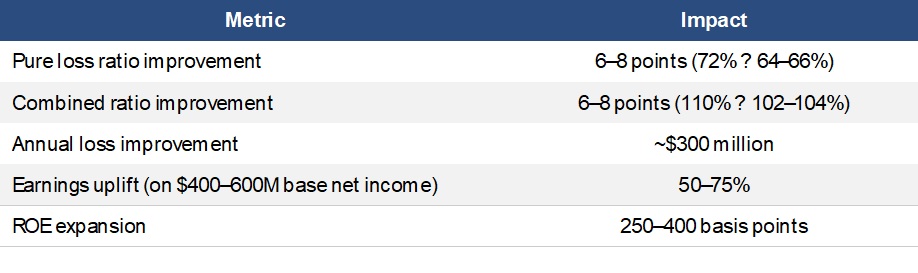
A 6-to-8-point improvement in the combined ratio on a structurally unprofitable book is not incremental. It is the difference between a line of business that destroys capital and one that begins to earn its cost of capital. As every carrier executive knows—that changes the strategic calculus around which lines to grow, which to exit, and how to deploy surplus.
A New Role for Claims and Litigation Leadership
For decades, claims and litigation management has been categorized as an expense function. Leadership performance is measured by cycle time, closure rates, and whether the department stayed within budget. This framing is outdated and, in the current environment, actively harmful.
The numbers above demonstrate that claims and litigation leadership sits on top of one of the largest financial levers in any P/C organization. The liability indemnity line—the line most directly influenced by how we negotiate — is larger than the entire underwriting expense base. It is larger than total LAE. It is, by a wide margin, the single biggest variable cost a carrier has.
Yet we have historically treated the people who control this cost as operators, not strategists. We have measured them on efficiency, not on value creation.
The plaintiff bar’s investment in AI has changed the equation. When one side of the negotiating table is systematically improving its ability to extract value, standing still is not a neutral position. It is a guaranteed loss of ground. And every point of ground lost on the pure loss ratio translates directly to shareholder value destroyed.
Conversely, every point recovered through better negotiation discipline, earlier positioning, written evidence-based advocacy, and defense-side AI translates directly to earnings, return on equity, and competitive advantage.
Related articles: The Power of the First Offer: Anchoring, Evidence and the Battle for Perception; Negotiation by Design: Why Writing Beats Talking
All settlement decisions remain grounded in the insurer’s duty of good faith to protect the insured from excess exposure. Financial improvement flows from disciplined claim handling— not from deprioritizing insured interests.
This is not a technological argument. It is a financial governance argument. The question for boards and C-suites is straightforward: If the single largest controllable cost in your organization is liability indemnity, and the tools now exist to improve how that cost is managed, what is the cost of inaction?
What This Means in Practice
None of this requires carriers to adopt unproven technology or abandon professional judgment. It requires three things.
First, acknowledge the financial magnitude. A 1-point improvement in the pure loss ratio on a $4.75 billion liability book is worth approximately $47.5 million annually. Two points is $95 million. Claims leaders who can articulate this math to their boards will find that investment conversations become much easier.
Second, invest in negotiation capability as a financial discipline, not merely an operational one. Multiple recent articles have laid out the evidence: written advocacy outperforms verbal, first offers anchor outcomes, and structured negotiation frameworks reduce variability. These are not opinions. They are research-backed practices that the plaintiff bar has already operationalized. By putting our analysis on the table in writing, we invite scrutiny, correction, and dialogue—a process that is more transparent and fair than exchanging unsupported numbers over the phone.
Third, adopt defense-side AI tools that enable evidence-based advocacy at scale. The plaintiff bar’s advantage is not just that their tools produce better demand packages. It is that they produce them at volume. One attorney can now generate dozens of calibrated demands per week. The defense must match this capability or accept an accelerating disadvantage. AI tools assist in organizing records and surfacing relevant issues, but settlement authority remains with experienced claim professionals who evaluate the facts, set strategy, and stand behind the offers they authorize.
The Bottom Line
The plaintiff bar has made a clear, capital-backed bet that AI-enhanced negotiation will increase the cost of insurance litigation and that insurance companies will be out-negotiated and pay more. They are winning that bet.
To be clear: where liability and damages clearly warrant policy limits, disciplined evaluation supports timely tender—not resistance. The goal is accuracy and documentation, not suppression.
The defense has an equally clear opportunity. The same technology, applied to the same negotiation dynamics, can recover value that is currently being left on the table. The financial impact—measured in hundreds of millions of dollars per carrier, in combined ratio points, in ROE expansion—is large enough to warrant board-level attention.
Claims and litigation leaders are no longer managing an expense function. They are managing the largest controllable financial variable in the enterprise. The sooner our industry recognizes this fact, the sooner we can respond to what is, without exaggeration, the most consequential operational shift in P/C claims in a generation.
***

Need a full playbook for better negotiation?
Download the PDF titled, “The Art of Negotiation: How to Lower Claims Costs by Controlling Social Inflation Internally” containing all the articles in Carrier Management’s Negotiation Reclaimed Series, presented by Guest Editor Taylor Smith.
AI generated images (ChatGPT and Adobe Firefly)
 Nvidia, Huang Face Shareholder Lawsuit Alleging Investors Were Misled About Spy Affair
 El Niño’s Odds of Being Worst Ever Edge Lower, US Climate Prediction Center Says
 Policy Disconnects, Deferred Mitigation Escalate Weather-Related Claims
 New Florida Property Tax Cut Could Impact Insurance Rates