



















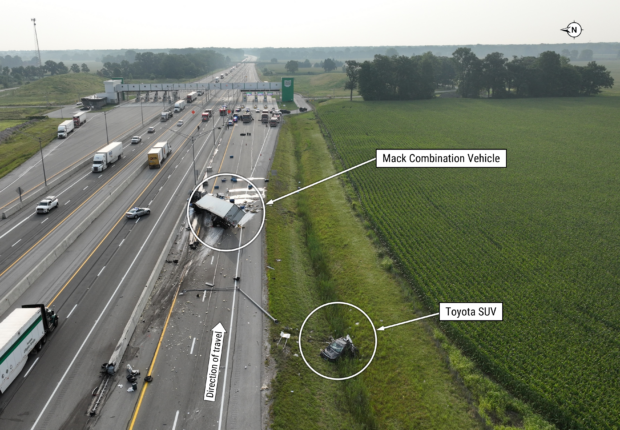
A deadly crash at a toll plaza on Interstate 80 near Swanton, Ohio, in 2024 could have been avoided if the turnpike used fully electronic tolling and provided clearer information about toll payment options, according to findings by the National Transportation Safety Board.
On August 15, 2024, a crash occured the Swanton Township Toll Plaza on the Ohio Turnpike.
A SUV was traveling in the left lane of the high-speed toll lanes when it suddenly slowed and moved across the path of a truck-trailer while attempting to enter the low-speed manual toll booth lanes on the right side of the toll plaza. The truck struck the SUV from behind and overturned.
As a result of the crash, two passengers in the SUV died, the driver and another passenger were seriously injured, and the driver of the truck was seriously injured, the NTSB reported.
Sulfonic acid carried by the truck also spilled following the rollover, but no injuries were reported from exposure to the chemicals.
NTSB investigators determined that the toll plaza’s hybrid design, which combines high-speed electronic tolling lanes with separated low-speed manual tolling lanes, increased the risk of a severe crash by creating conditions that encourage last-minute sudden lane changes and large speed differences between vehicles.
Video of the Swanton toll plaza over a three-week period showed 1,099 similar last-minute lane changes — an average of 52 per day — with vehicles illegally traveling through the marked area between the high-speed and low-speed tolling lanes.
Illinois and Pennsylvania have already implemented fully electronic tolling on their portions of the Interstate 80 turnpike.
The investigation also found that emergency responders were delayed because they lacked direct access to the toll road. While investigators said this delay would not likely have changed the survivability of the crash, it does present risks for future crashes.
The NTSB recommends the turnpike commission evaluate the need for additional emergency access points at toll plazas and construct them where appropriate.
Investigators also found that vehicle occupants were not wearing seatbelts, which could have prevented their injuries and death. As a result, the NTSB is reiterating a 2014 recommendation to Ohio requiring the enforcement of seatbelt use for all vehicle occupants.
“This crash shows the deadly safety consequences of mixing high-speed electronic tolling with low-speed manual tolling lanes,” said NTSB Chairwoman Jennifer Homendy. “We encourage the Ohio Turnpike and Infrastructure Commission to implement fully high-speed electronic tolling, as states like Pennsylvania and Illinois have, and permanently close the low-speed lanes to make the roadway safer for everyone.”
As a result of the investigation, the NTSB is recommending that the Ohio Turnpike and Infrastructure Commission permanently close low-speed tolling lanes and implement fully electronic tolling at its toll plazas. The NTSB also recommended that the Federal Highway Administration adopt guidance on the safety benefits of fully electronic tolling.
Following its investigation, the NTSB issued recommendations to the Federal Highway Administration, the state of Ohio, the Ohio Turnpike and Infrastructure Commission, Springfield Township and the International Bridge, Tunnel and Turnpike Association.
 The Impact of Claims Experiences on Trust
  The Latest Launches from Orion180, Arbol, Zywave
  Monster Tsunami Sent Water 1,580 Feet Up an Alaskan Mountain
  AAA Survey Reveals Disconnect in Drivers’ Obeying ‘Slow Down, Move Over’ Laws