

















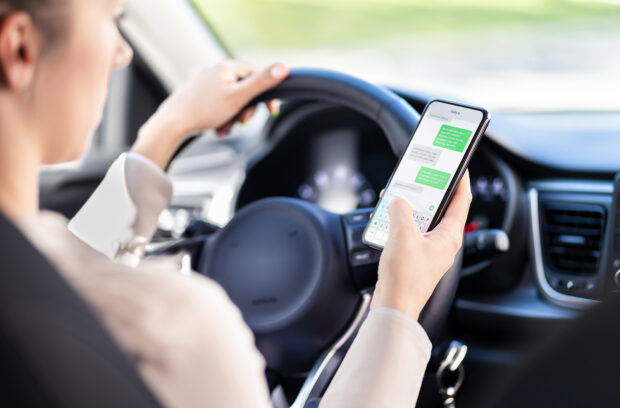
A new study drawing on telematics data confirms that far more drivers are using cellphones in the lead-up to crashes than is reflected in police reports, according to the Insurance Institute for Highway Safety.
The data, derived from driver-enrolled safe-driving apps, show that cellphone use prior to crashes is undercounted in police reports by a factor of at least 7.
“It’s widely accepted that police reports often fail to capture the role of cellphones in crashes. Many smartphone functions are hard for a witness to see, and drivers are reluctant to admit being distracted,” IIHS President David Harkey said. “Telematics are allowing us to understand the true magnitude of the problem.”
IIHS researchers examined anonymized cellphone data from Cambridge Mobile Telematics (CMT) and found that drivers enrolled in safe-driving programs that rely on the CMT platform were using their cellphones in the 30 seconds prior to impact in 7% of single-vehicle crashes and 8% of two-vehicle crashes.
Police reports for the same crashes recorded cellphone use in less than 1%.
The numbers include drivers whose screens were unlocked for any reason, including navigation, the IIHS noted.
The risk is greater for more complex tasks, like using smartphone apps, that take the driver’s eyes away from the road, researchers said. Looking away from the road for just two seconds doubles the risk of a crash or near-crash event.
To determine how often smartphone use is overlooked in police reports, IIHS researchers worked with CMT to link crashes recorded by safe-driving apps to police-reported crashes in four states between 2021 and 2024. Since police reports do not always record crash times and locations with perfect precision, crashes that occurred within the same 15-minute window and within the same one-mile radius were determined to be a match. This generated a sample of nearly 17,000 linked crashes.
Looking only at active cellphone use, the researchers found that drivers tapped, swiped or otherwise manipulated their phones before hundreds of crashes, while hands-free and hand-held calls were comparatively rare. Police reports noted almost none of this activity.
Driver cellphone use before crashes as captured by telematics data versus reported by police
| Hand-held calls | Hands-free calls | Manipulation | Passive use | |
|---|---|---|---|---|
| 15,301 two-vehicle crashes | ||||
| Telematics (within 10 seconds of impact) |
14 | 53 | 287 | 337 |
| Telematics (within 30 seconds of impact) |
19 | 87 | 590 | 534 |
| Police reports | 6 | 1 | 17 | 15 |
| 1,543 single-vehicle crashes | ||||
| Telematics (within 10 seconds of impact) |
2 | 0 | 23 | 40 |
| Telematics (within 30 seconds of impact) |
3 | 3 | 49 | 52 |
| Police reports | 1 | 0 | 3 | 5 |
Note: For two-vehicle crashes, telematics data captured and recorded behaviors of both drivers when both were users of apps supported by CMT.
Researchers also looked at how often the telematics data and police reports noted passive cellphone use. For the telematics data, this meant any time that the driver was not touching the device but the screen was unlocked. The police report categories used for comparison were broader and included behaviors such as “other activity with an electronic device,” “other electronic device — navigation, radio, etc.” and “cell/mobile device use — unknown.”
As shown in the table, passive use was about as common as active use in the 30 seconds prior to impact.
Navigation apps may have accounted for much of that passive activity. But nearly 25% of drivers who participated in a separate IIHS survey admitted to watching a video on their phone while driving at least once in the previous 30 days.
Even navigation apps can increase crash risk if drivers are looking away from the road ahead for too long. In a U.S. Department of Transportation study that tracked drivers during their everyday trips, many of the longest glances away from the road before crashes and near crashes were directed toward the center stack, a common location for cellphone mounts.
The telematics data offer no way of knowing how long drivers in the study sample spent looking at their unlocked screens before they crashed — if they were looking at them at all.
It’s also impossible to know how many additional drivers were using similar apps with CarPlay or Android Auto, since their use does not require the phone’s screen to be unlocked.
Even when police and telematics both indicated cellphone use, they usually didn’t agree about the type of use, researchers said. Police reports noted the same activity as the telematics data in only three out of nearly 17,000 linked crashes.
Police may not always be able to determine exactly how a driver was using a cellphone after a crash, a challenge compounded by the fact that in many jurisdictions, only certain types of cellphone use are illegal, the IIHS study said, noting that telematics data could be the solution to closing that disconnect.
 The Technology Taking Parametric Insurance Mainstream
  Men Sentenced in Multi-State Stolen Construction Equipment Scheme
  Hurricane Hunter Data Reveals 4 Signs of a Strengthening Storm
  US States Allege Corteva Spinoff a Bid to Evade PFAS Liabilities